AirOps alternatives in 2026: seven AI content workflow tools compared
AirOps alternatives for teams that want AI content production without task math or a sales call. Seven tools compared on price, publishing, tracking and what each leaves out.
AirOps sits in an odd spot on most shortlists. It is a workflow engine for content: agents, brand kits, knowledge bases and a builder that turns a research-to-publish process into something repeatable. Teams that like building pipelines get a lot out of it. Teams that wanted to buy an outcome sometimes find they bought a construction kit instead.
The pricing page we captured on November 6, 2026, shows the reason many people start looking around. It lists three plans and no prices. Solo offers ChatGPT insights only, 35,000 tasks for content production, one brand kit, three knowledge bases, basic CMS and SEO integrations, and single-user access. Pro moves to insights across 10+ answer engines, 100,000 tasks, five knowledge bases, a wider integration set and unlimited seats. Enterprise is custom. The buttons say "Start for free" and "Work with us," and our catalog notes that extra Solo tasks cost $0.025 each. You can't budget a quarter from that page alone.
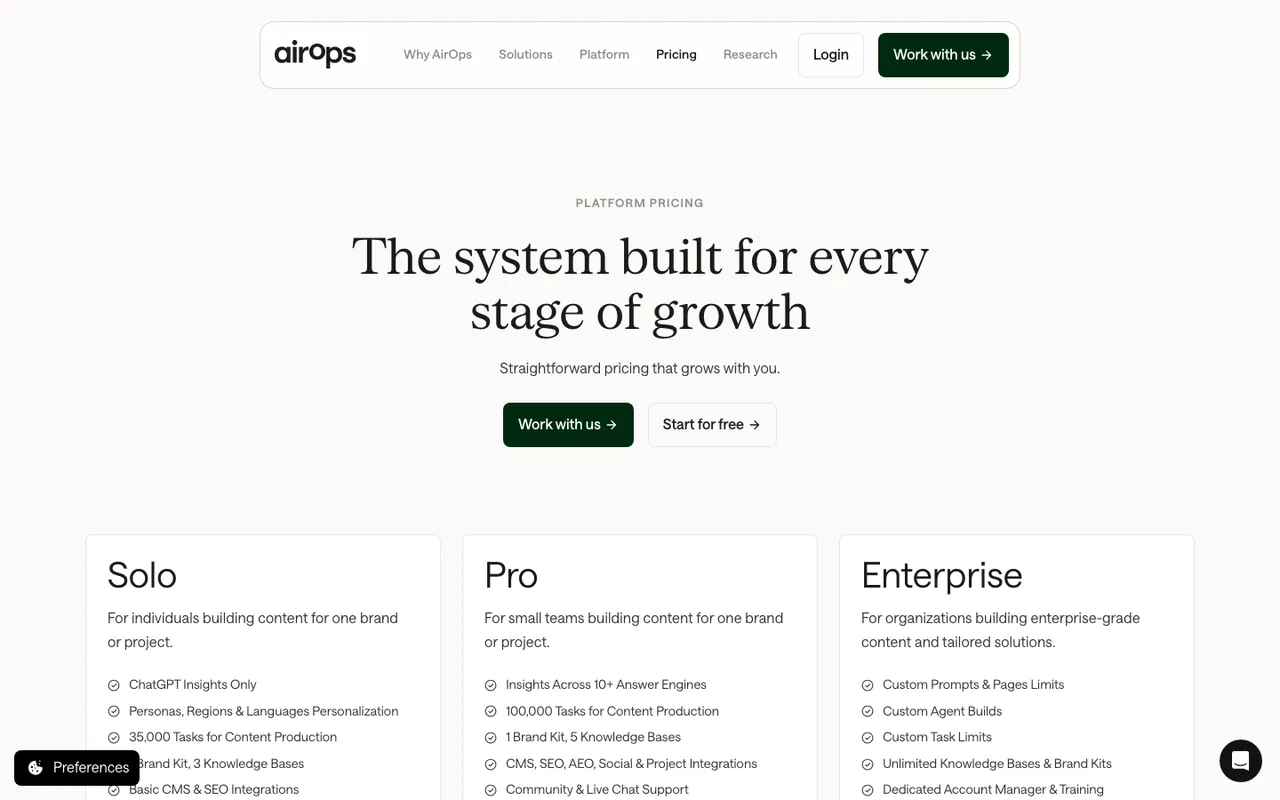 AirOps' pricing page, captured November 6, 2026.
The homepage has also moved toward services. It leads with "Run the strategy that wins AI discovery" and says the AirOps team "stays hands-on from setting strategy through execution." That suits a company that wants a partner. It is less useful if you wanted a self-serve tool with a price on it. And AirOps is not an AI visibility platform in the narrow sense: our catalog notes it doesn't replace prompt tracking, citation analytics or crawler logs, and its Solo insights cover ChatGPT alone.
So the alternatives below fall into two groups. Some replace the content production. Others replace the production and add the measurement AirOps leaves to other tools.
Quick verdict
Promptwatch is the strongest alternative if the goal is content that gets cited, because it writes against gaps it has measured and then follows each page through AI crawls, citations and AI-referred traffic. AthenaHQ is the pick if you want an action queue with a content agent attached. Writesonic GEO bundles an article writer and basic tracking at the lowest published price. Frase is the cheapest route from research to a published draft on WordPress, Webflow, Sanity or Wix.
AirOps alternatives compared
| Tool | Best for | Starting price | What it doesn't do |
|---|---|---|---|
| Promptwatch | Content tied to measured AI visibility gaps, then tracked after publishing | $95/mo; AEO articles from Professional ($245/mo); Content Agent from Business ($579/mo) | Publishes to WordPress, Webflow and Framer only; agency plans exclude the Content Agent |
| AthenaHQ | Teams that want actions plus a content agent | Free Essential tier; Starter $295/mo | Credit billing; multi-region and personas are Enterprise |
| Writesonic GEO | One bill for articles and basic tracking | $79/mo billed annually | Self-serve plans track three engines; the full Action Center is Enterprise |
| Goodie AI | Agent-run optimization, including technical fixes | Core $295/mo, 7-day free trial | Which agents come with which plan isn't spelled out on the page |
| Frase | Small teams going from research to published draft | $39/mo billed yearly, $49 monthly | Starter has 20 AI Visibility prompts; tracking is secondary |
| Surfer | Editor-led optimization with a separate tracking plan | €49/mo billed yearly (Discovery) | Discovery has no prompt tracking; Standard tracks 25 prompts weekly |
| Clearscope | Writers who want a simple grading editor | $129/mo | No publishing agent described; 50 tracked queries on Essentials |
| AirOps (reference) | Ops-minded teams building custom workflows | Free start; plan prices not shown | Solo insights are ChatGPT only; no crawler logs in our catalog |
Prices are from each vendor's pricing page or homepage as captured on November 6, 2026, or from our catalog where the page showed none.
1. Promptwatch: writing against measured gaps, then checking the result
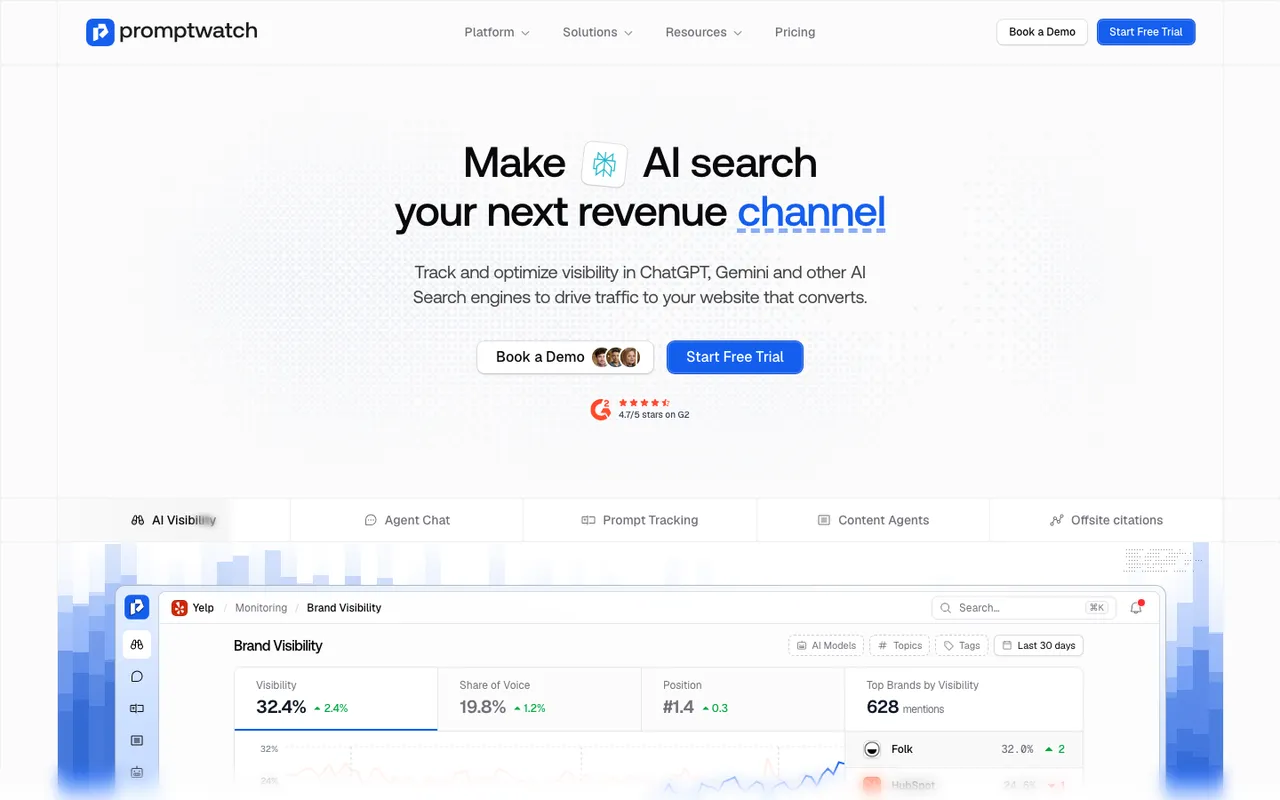 Promptwatch's homepage, captured November 6, 2026.
The difference between Promptwatch and AirOps is where the content starts and where it ends. AirOps gives you a builder and lets you decide what to feed it. Promptwatch starts from what it has measured: tracked prompts, query fan-outs, content gap analysis with coverage scores, and the pages AI engines already cite. You can write about any topic, tracked prompt, fan-out or cited page, from a brief that pulls in your branding, Google results, news, internal links, YouTube transcripts, live page screenshots and up to five competitor URLs. It picks internal links before writing, favoring your pages with many Search Console impressions but few clicks.
Content Creation on demand starts on Professional ($245 a month), which includes 5 AEO articles, a Knowledge Base of 100 items and Content Refresh, which suggests diff-style updates for pages you already have. Business ($579) raises that to 10 articles and adds the automated Content Agent. It plans, writes and publishes on a schedule, with a publishing calendar, a monthly budget and publish windows, and either a review inbox (approve, edit, decline) or fully automated mode. Publishing goes to WordPress through the official plugin, to Webflow over OAuth, or to Framer with an API key. Markdown and HTML export cover anything else.
Then comes the part AirOps leaves to other tools. Publish status tracking follows each document from draft to live URL, and then through AI crawls in Agent Analytics, citations in Page Tracker, and AI-referred visits and conversions in Visitor Analytics. Pages that underperform come back as Action Board items and Content Refresh suggestions. Every brand plan includes a 7-day free trial on monthly billing and unlimited seats.
Limits: there is no Shopify, Sanity or Wix publishing listed, and the self-serve agency plans don't include the Content Agent or AEO articles. If you want a blank canvas to design arbitrary workflows, AirOps' builder is more open-ended.
2. AthenaHQ: an action list with a content agent
AthenaHQ approaches content from the action side. Starter ($295 a month) includes on-page and off-page actions, a content optimization agent and "self-learning content improvement," alongside visibility across 11 models. Its FAQ says the Shopify integration publishes AEO-optimized content and attributes revenue, and that it also connects to Webflow and Framer. A free Essential tier with 300 credits works as a trial.
The trade-off is billing. One credit equals one AI response and Starter includes 3,600 a month, so the content budget and the tracking budget draw on the same pool. API access and extra credits are paid add-ons on Starter. Our catalog documents no AI crawler-log product. AthenaHQ suits teams that want someone to tell them what to change and are happy to do the writing inside that queue.
3. Writesonic GEO: articles and tracking on one bill
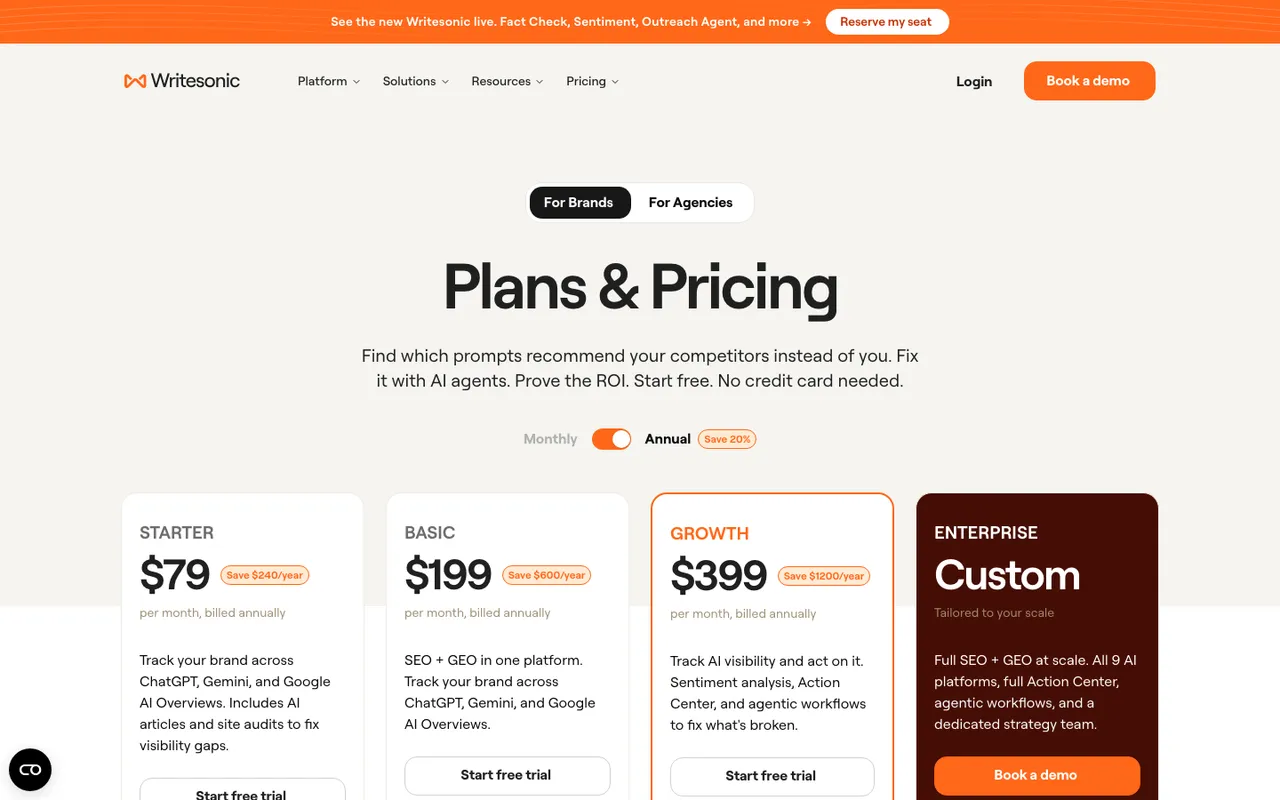 Writesonic's pricing page, captured November 6, 2026.
Writesonic GEO is the most direct budget swap. Billed annually, Starter is $79 a month for 50 tracked prompts, 15 AI articles and 10 site audits. Basic is $199 for 100 prompts and 25 articles, and Growth is $399 for 200 prompts, 50 articles, sentiment analysis and an Action Center trial of five on-page and five off-page actions a month. Every self-serve plan tracks ChatGPT, Gemini and Google AI Overviews daily, includes ads monitoring, and the plan table lists Google Search Console, WordPress and GA4 integrations. The homepage describes an agent that rewrites pages for GEO by adding FAQ blocks, comparison tables and self-contained passages.
The ceiling arrives quickly. The full Action Center, all nine AI platforms, Fact Check and the Outreach Agent are Enterprise. Agentic workflows on self-serve plans are limited to trial runs (10, 50 or 100). Writesonic suits a small team that mainly needs articles and wants a visibility signal next to them.
4. Goodie AI: agents that also fix the technical layer
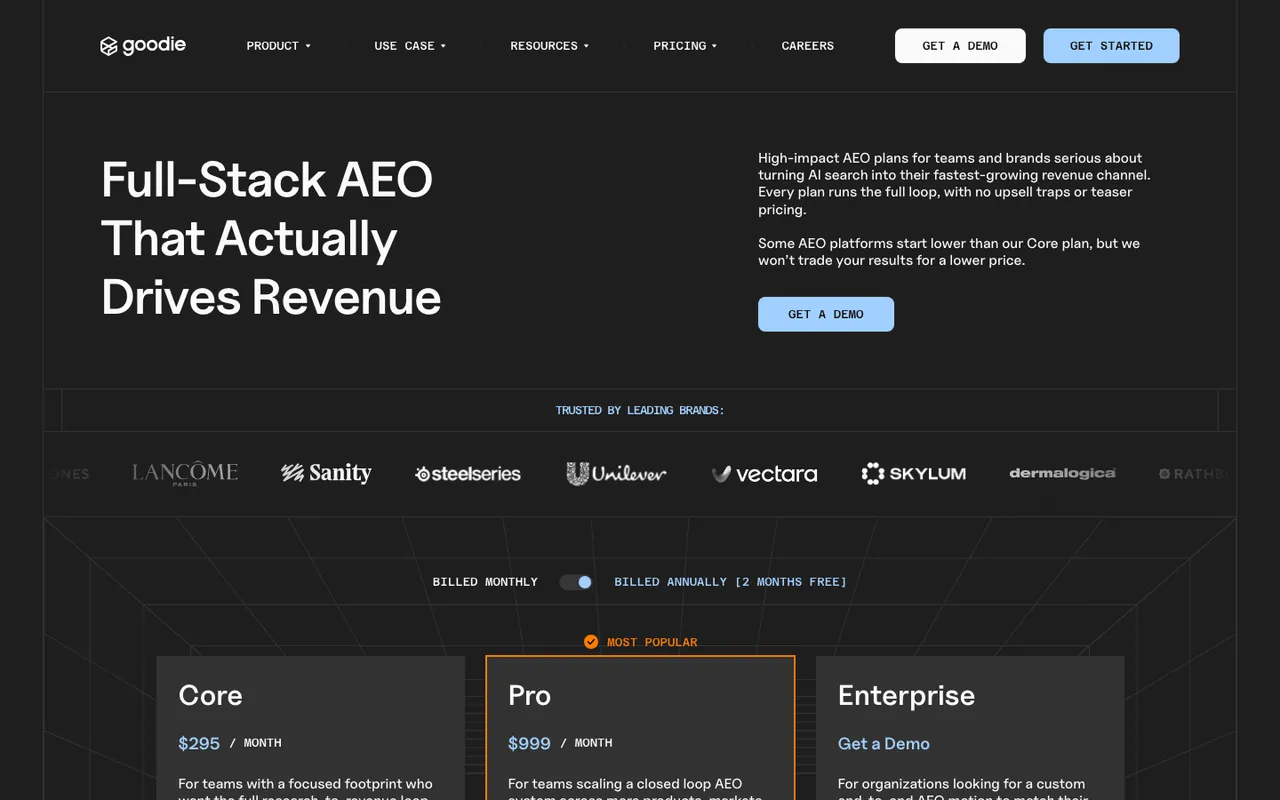 Goodie's pricing page, captured November 6, 2026.
Goodie AI is the closest to AirOps in spirit, because it is built around agents doing the work. Its pricing page lists an AEO content writer, content optimization, blog generation, an outreach agent, a technical agent, llms.txt and sitemap repair, and a social agent. Core is $295 a month for five tracked models, 110 prompts, MCP access, 50 optimizations a month and unlimited seats, with a 7-day free trial. Pro is $999 for eight models, 250 prompts and 100 optimizations, and adds SKU-level agentic commerce visibility. The integration list includes WordPress, Shopify, Cloudflare, Vercel and HubSpot.
Two cautions. The page doesn't say which agents come with which plan, and it doesn't make clear which billing period the shown prices use. Ask both questions on the demo. Goodie suits teams that want agents to handle content and technical fixes together, with a strategist included.
5. Frase: research to publish, cheaply
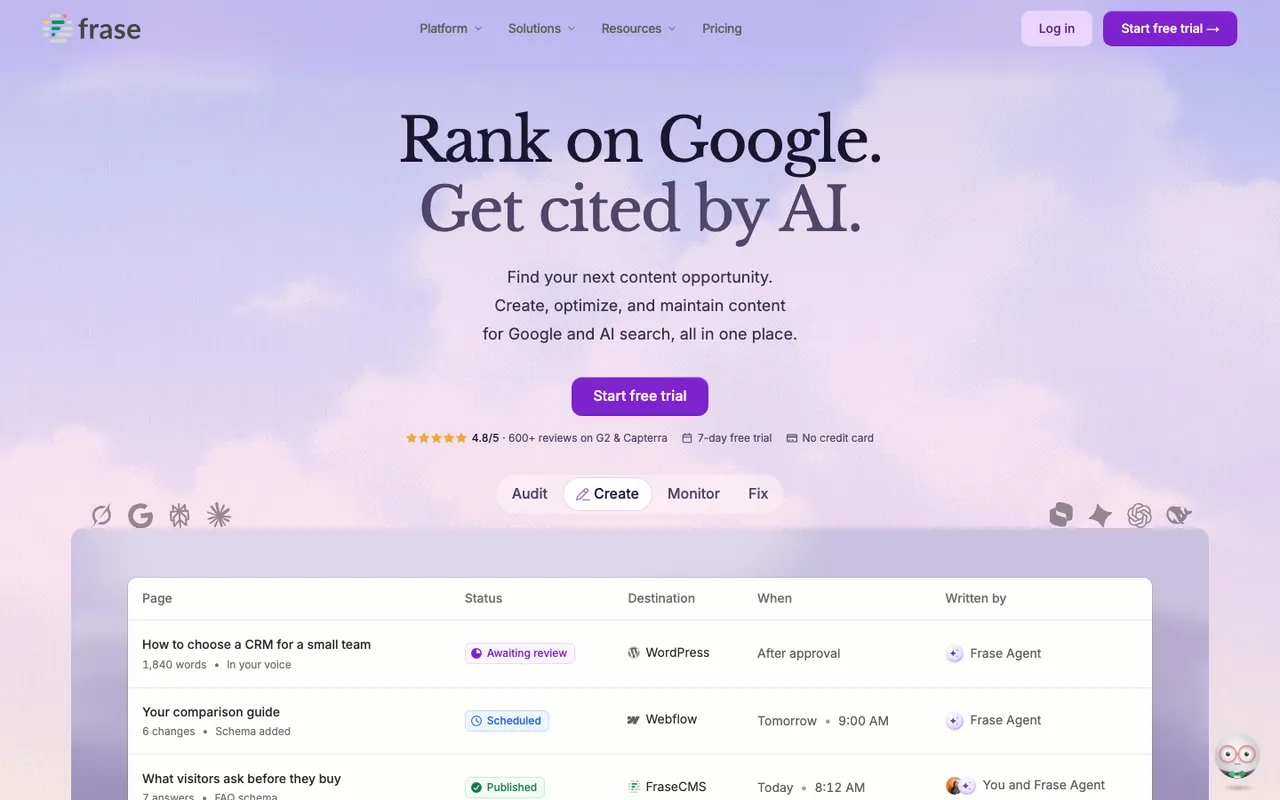 Frase's homepage, captured November 6, 2026.
Frase now calls itself a content operating system for AI search. It researches, drafts, optimizes and publishes to WordPress, Webflow, Sanity, Wix or its own FraseCMS, and you decide what it may publish without asking. An MCP server lets you run steps from Claude or Cursor. Starter is $39 a month billed yearly or $49 monthly for one seat, one site and 10 articles. Professional is $103 yearly or $129 monthly for three seats, five sites and 40 articles. The 7-day trial needs no card.
AI visibility tracking is a side feature here. Our catalog lists 20 AI Visibility prompts on Starter, on ChatGPT and Google AI, and AI crawler monitoring from Professional. Frase suits a small team that wants the AirOps outcome (a steady flow of published, structured pages) without building the workflow.
6. Surfer: the editor, with tracking sold separately
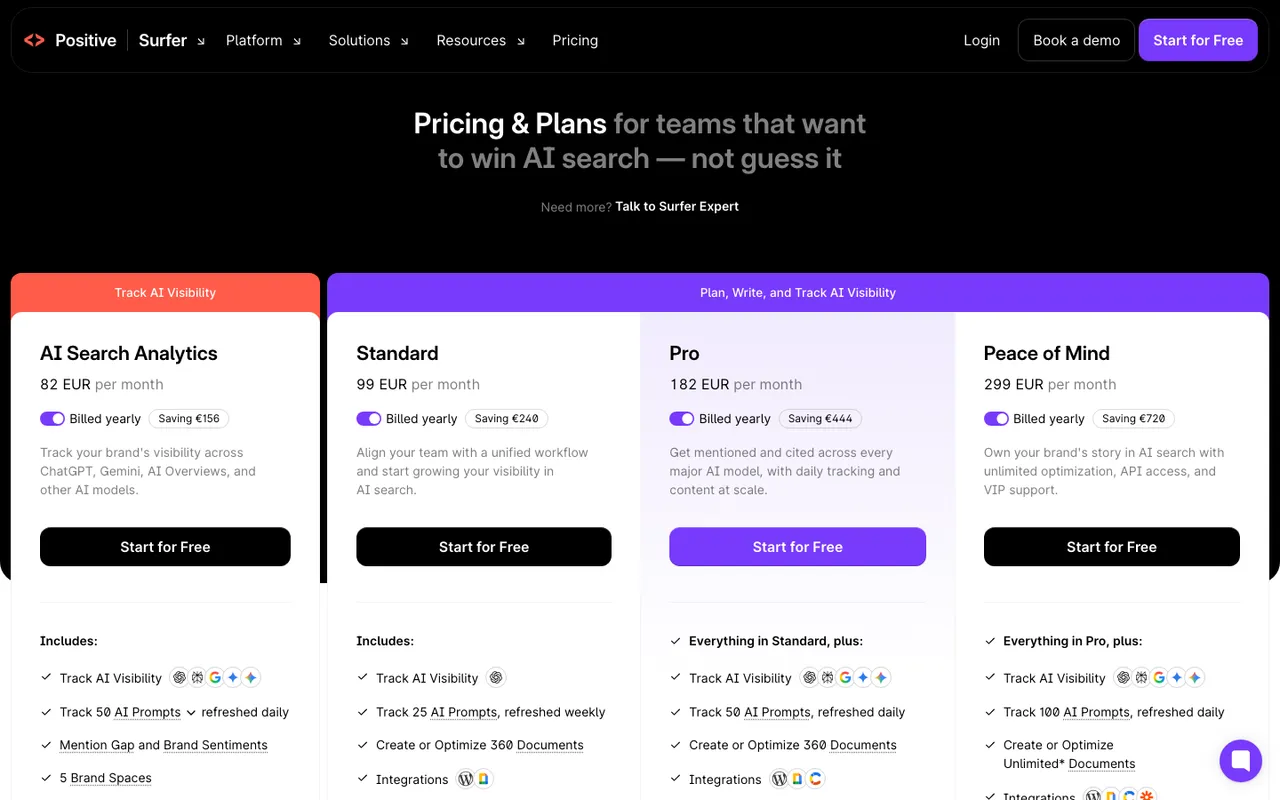 Surfer's pricing page, captured November 6, 2026. Prices shown in euros for a visitor in the Netherlands.
Surfer is built around its content editor and optimization score. Billed yearly, Discovery is €49 a month for 120 documents and 10 tracked pages, with no prompt tracking. Standard (€99) tracks 25 AI prompts weekly and covers 360 documents. Pro (€182) moves to 50 prompts refreshed daily and adds internal linking and coverage gap reports. Peace of Mind (€299) tracks 100 prompts daily with API access. A separate AI Search Analytics plan (€82) tracks 50 prompts daily without the writing tools. MCP access appears on several plans, and there is a WordPress integration.
Surfer suits writers who want guidance while they draft. It is not a pipeline tool, and on the cheaper tiers the AI tracking is thin.
7. Clearscope: a grading editor that now watches AI answers
Clearscope is the simplest tool here. Its homepage describes four steps: discover the questions buyers ask, track whether Google, ChatGPT, Gemini and Claude mention you, write the page, and monitor it after it ships through Search Console. Drafting works in Google Docs, Microsoft Word and WordPress, and a content strategist works inside the account. Our catalog lists Essentials at $129 a month (50 tracked queries, 50 pages, 20 Drafts) and Business at $399, with unlimited users on every plan.
It has no publishing agent and no workflow builder, which is either the point or the problem. Clearscope suits editorial teams that value a clean writer experience over automation.
Who should pick which
- You want content written against measured gaps and proof it got crawled and cited: Promptwatch, on Business if you want the Content Agent to run on a schedule.
- You want a ranked action list that includes content work: AthenaHQ.
- You want articles plus a basic visibility signal for under $100 a month: Writesonic GEO.
- You want agents to handle technical fixes and outreach as well as content: Goodie AI.
- You publish to Sanity or Wix, or want the cheapest research-to-publish tool: Frase.
- Your writers live in a content editor: Surfer or Clearscope.
- You really do want to design custom LLM workflows and have an ops person to run them: stay on AirOps. None of these replaces its builder one for one.
Our recommendation
AirOps is good at producing content. What it doesn't tell you, from what our catalog documents, is whether that content was read by GPTBot, cited by ChatGPT, or worth a visit. For content aimed at AI answers, that feedback is most of the job. Promptwatch closes it in one place: the Content Agent writes against gaps it measured, publish status tracking follows the page to its live URL, and Agent Analytics and Page Tracker show whether AI crawlers fetched it and whether engines cite it. If you want to see how that loop looks with your own gaps, book a Promptwatch demo and ask them to walk through one page from brief to citation.
FAQ
Does AirOps publish its prices?
Not on the pricing page we captured on November 6, 2026. It lists Solo, Pro and Enterprise with their limits, plus "Start for free" and "Work with us" buttons, but no dollar amounts. Our catalog notes extra Solo tasks cost $0.025 each.
Which AirOps alternative also tracks AI visibility properly?
Promptwatch is the one built for both: tracking across the major engines, citation analytics, crawler logs and visitor analytics, with content generation on top. AthenaHQ tracks 11 models on Starter. Writesonic, Frase, Surfer and Clearscope track a smaller set and treat tracking as secondary.
Which alternatives publish straight to a CMS?
Promptwatch publishes to WordPress, Webflow and Framer. Frase publishes to WordPress, Webflow, Sanity, Wix and FraseCMS. AthenaHQ's FAQ describes publishing through its Shopify integration. Writesonic and Surfer list WordPress integrations.
Is there a cheaper alternative to AirOps for content production?
Frase starts at $39 a month billed yearly and Writesonic GEO at $79 billed annually, both with published limits. Because AirOps shows no plan prices, a direct price comparison isn't possible from its page.
Do these tools replace the AirOps workflow builder?
No single tool here copies the open-ended builder. They replace the outcome instead: briefs, drafts, optimization and publishing, with varying amounts of measurement attached.