AI search visibility tools for enterprise, compared head to head (2026)
AI search visibility tools for enterprise compared on SSO, audit logs, compliance, multi-market scale, data access and proof of revenue: Promptwatch, AthenaHQ, Scrunch, Profound, Evertune and Brandlight.
Quick verdict
Start with Promptwatch. Of the AI search visibility tools for enterprise we compared, it is the only one where every control a security reviewer asks about is written on a public page (SSO, audit log, roles with project-level access, scoped API keys, ISO/IEC 27001 certification), and where the data goes past mention counts into IP-verified crawler logs and AI-referred conversions. AthenaHQ comes closest on governance, but nearly all of it sits in a custom Enterprise tier. Scrunch is the pick if you want to change what AI crawlers receive from your site. Profound fits a marketing org that is buying an agent program rather than a search team that wants a tracker. Evertune and Brandlight are demo-only and make sense for narrower cases.
Our enterprise GEO platforms guide ranks a wider field for procurement. This post is narrower. It puts six tools side by side, criterion by criterion, so you can see where each one actually differs.
The six criteria we compared
Enterprise buyers rarely lose a deal on features. They lose months on things like an SSO review, a data protection questionnaire, or a pricing model nobody can forecast. So we compared on the questions that tend to stall a purchase:
- Identity and access. SSO, role-based permissions, and an audit log that shows who changed what.
- Compliance paperwork. Which certification or attestation the vendor names publicly.
- Scale across markets. Projects or workspaces, seats, and whether state, city, or multi-language tracking costs you a tier jump.
- Data out. API limits, MCP access, and BI connectors, because enterprise GEO numbers end up in someone else's dashboard.
- Evidence past the mention. Crawler data, citation sources, and AI traffic tied to conversions.
- Evaluation path. Whether your team can test the product on your own brand before a contract.
Every cell below comes from the vendor's own pricing page or our catalog entry for that tool. "Not published" means exactly that. It does not mean the feature is missing, only that you will have to ask for it in writing.
Head-to-head comparison table
| Promptwatch | AthenaHQ | Scrunch | Profound | Evertune | Brandlight | |
|---|---|---|---|---|---|---|
| SSO | Enterprise | SAML and OIDC, Enterprise | SAML and OIDC, Enterprise | SSO/SAML, Enterprise | Not published | Listed |
| Audit log | Business, Agency Scale, Enterprise | Organization audit log, Enterprise | Not listed | Not listed | Not published | Not published |
| Compliance named | ISO/IEC 27001, GDPR, EU-based | Not on pricing page | Not on pricing page | SOC 2, Enterprise | Not published | SOC 2 Type II |
| Seats | Unlimited on every paid plan | Unlimited users | 5 licenses on Core, custom on Enterprise | Credits for the whole team on Enterprise | Not published | Role-based access |
| Multi-market | State and city from Business; any language | Multi-region and multi-language on Enterprise | Custom brand workspaces on Enterprise | Up to 9 answer engines on Enterprise | 11 models | Multi-brand, multi-region |
| Data out | MCP + API on every paid plan, 50,000 requests/hour on Enterprise; Looker Studio from Professional | API as paid add-on; BI dashboards (Tableau, Power BI, Looker) on Enterprise | API and Looker Studio on Enterprise | Not detailed | Manual BI exports on our listing | Not published |
| Crawler data | IP-verified Agent Analytics from Professional | Not published | AI agent and bot traffic reporting | Agent Analytics listed | Not published | Not published |
| AI traffic to conversions | Visitor analytics on every plan | Google Analytics connection | Not published | Not published | Not published | Not published |
| Try before contract | 7-day trial on monthly self-serve plans, up to Business | Free tier, 300 credits | 7-day trial on Core | Free 7-day trial, 50 prompts | Demo only | Demo only |
Two rows decide most enterprise shortlists: audit log and AI traffic to conversions. Only Promptwatch publishes both, and it puts the audit log on a self-serve plan, not only behind a custom contract.
Promptwatch: the most complete published enterprise stack
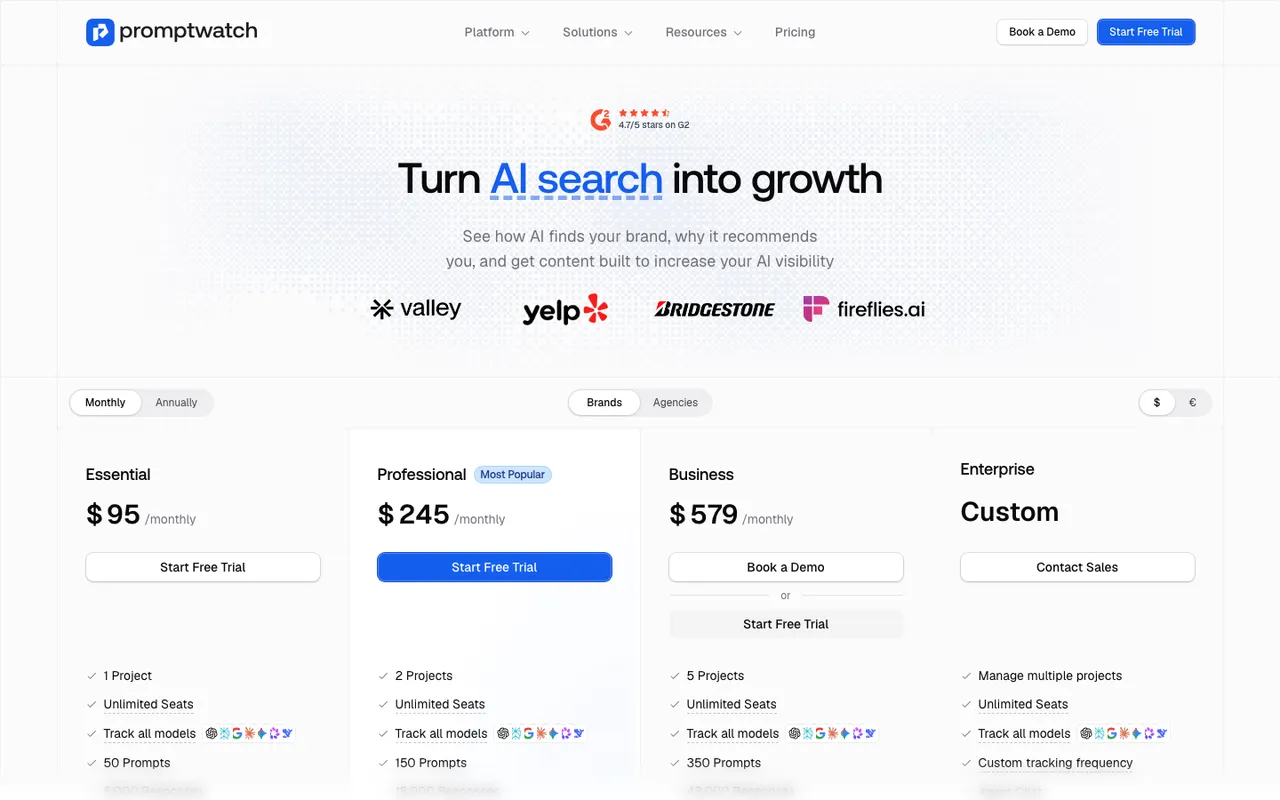 Promptwatch's pricing page, captured November 6, 2026.
The Enterprise plan is custom and adds the things procurement asks for: SSO, an audit log, a dedicated success manager, priority support, managed content workflows, faster tracking on request, and MCP + API access at 50,000 requests an hour. Below that, the published plans already carry most of the governance layer. Seats are unlimited on every paid plan, roles are owner, editor, and viewer with project-level access, and API keys can be scoped to a project, an organization, or read-only. The audit log starts on Business ($579 a month) and records whether a change came from the dashboard, the API, an MCP client, or Agent Chat. That last detail matters more than it sounds once agents are allowed to edit monitors.
On compliance, Promptwatch is ISO/IEC 27001 certified and GDPR compliant, and data is handled by an EU-based company. For a European enterprise that often shortens the data protection review.
The bigger difference is the data itself. Monitoring is the first step, not the whole product. Agent Analytics reads AI crawler logs from your CDN (Cloudflare, CloudFront, Fastly, Akamai, Vercel, Netlify, Google Cloud CDN, a custom HTTP endpoint, or the WordPress plugin), checks each bot against the operator's published IP ranges, and gives every page a citation rate. That tells your team whether a page has an access problem or a content problem. Visitor analytics then ties AI-referred visits to conversions. Pages that underperform come back as Action Board items. Most tools in this table stop at the dashboard.
The named customers fit the enterprise profile: Yelp, Typeform, Shutterstock, Rabobank, ABN AMRO, and agencies such as Monks and WPP. Monks, whose clients include Netflix and BMW, uses the Answer Gap Report and Visibility Score for client content roadmaps, with dashboards that combine LLM visibility with organic and paid search.
AthenaHQ: strong controls, mostly in the custom tier
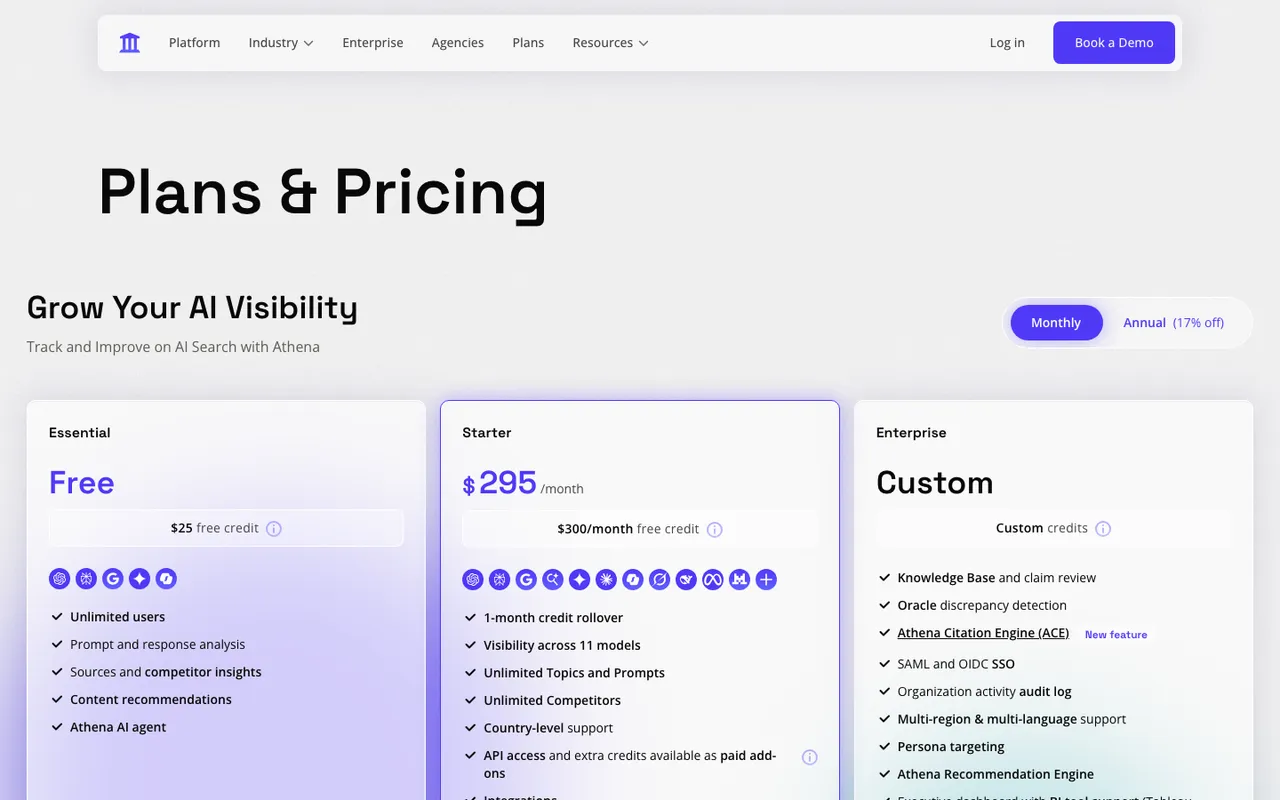 AthenaHQ's pricing page, captured November 6, 2026.
AthenaHQ's Enterprise column reads well on paper. It lists the Athena Citation Engine, SAML and OIDC SSO, an organization activity audit log, multi-region and multi-language support, persona targeting, BI dashboards for Tableau, Power BI, and Looker, and white-glove setup. Users are unlimited.
The catch for enterprise buyers is the step between tiers. Starter ($295 a month) covers 3,600 credits, where one credit equals one AI response, across 11 models, but it is country-level only, and API access is a paid add-on with the price on request. So a global team can't test multi-region tracking, SSO, or the audit log on a self-serve plan. Credit billing also needs forecasting. Prompts times engines times frequency adds up quickly, and our catalog entry records reviewers who ran out early. Our listing doesn't document a crawler-log product, and attribution runs through a Google Analytics connection rather than a dedicated AI-visitor view.
Scrunch: the crawler-side option
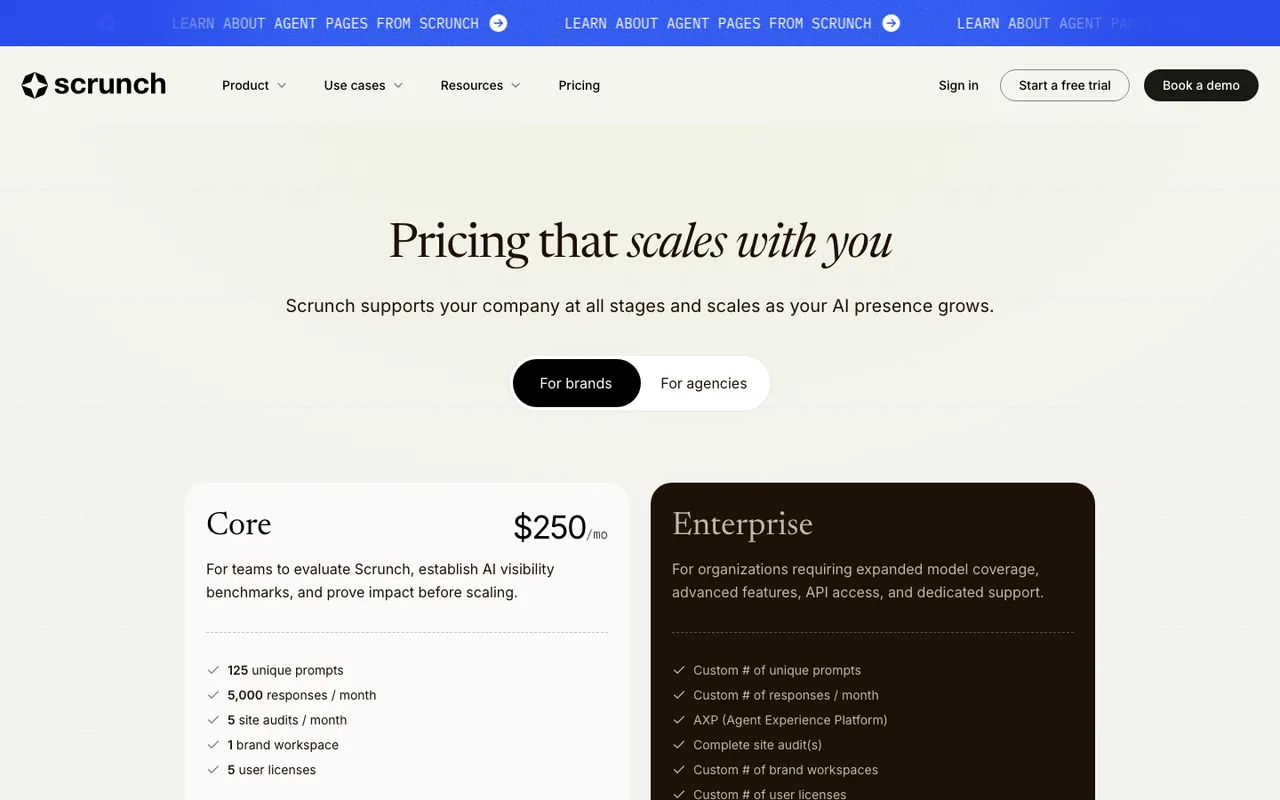 Scrunch's pricing page, captured November 6, 2026.
Scrunch is the only tool here that sells a way to change what AI agents receive. Its Agent Experience Platform (AXP) serves AI-optimized versions of pages to LLM crawlers without changing the human site. AXP is Enterprise only, along with SAML and OIDC SSO, API access and integrations, custom brand workspaces, and expanded model coverage. Core, at $250 a month, is an evaluation tier: 125 unique prompts, 5,000 responses, 5 site audits, one brand workspace, 5 user licenses, and four LLMs (ChatGPT, Perplexity, Google AI Overviews, Copilot).
Two enterprise caveats. Scrunch was acquired by Sitecore in June 2026 according to our catalog entry, so the roadmap now sits inside a DXP vendor. That's a plus for Sitecore customers and a question for everyone else. And while Scrunch reports AI bot traffic, our listing doesn't document AI-referred conversions or a per-page crawl-to-citation path.
Profound: an agent program, priced as one
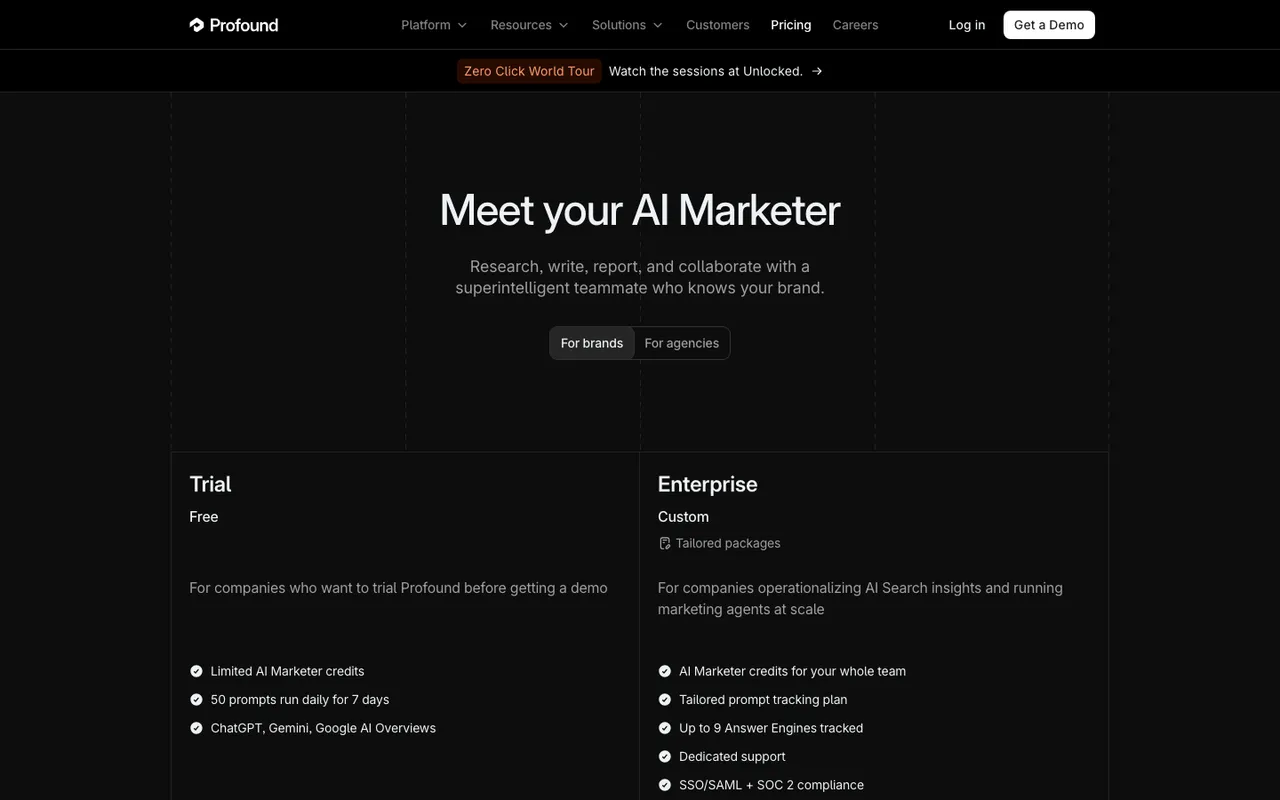 Profound's pricing page, captured November 6, 2026.
Profound now sells an "AI Marketer" with agents for research, content, and reporting. The public page lists two options. The free Trial runs 50 prompts daily for 7 days on ChatGPT, Gemini, and Google AI Overviews. Enterprise is custom, with up to 9 answer engines, SSO/SAML, SOC 2, dedicated support, and agent credits for the team. Our catalog carries an earlier estimate of about $40k a year for Enterprise, which isn't on the current page, and records one to three months of setup with a dedicated owner.
That shape suits a central marketing team that wants agents across content and demand work. It suits a search team less well, because Profound's own pricing page answers the question "Is Profound only for AI search?" with a no. Profound does list Agent Analytics, so ask to see bot-level detail and conversion data in the demo.
Evertune and Brandlight: demo-only specialists
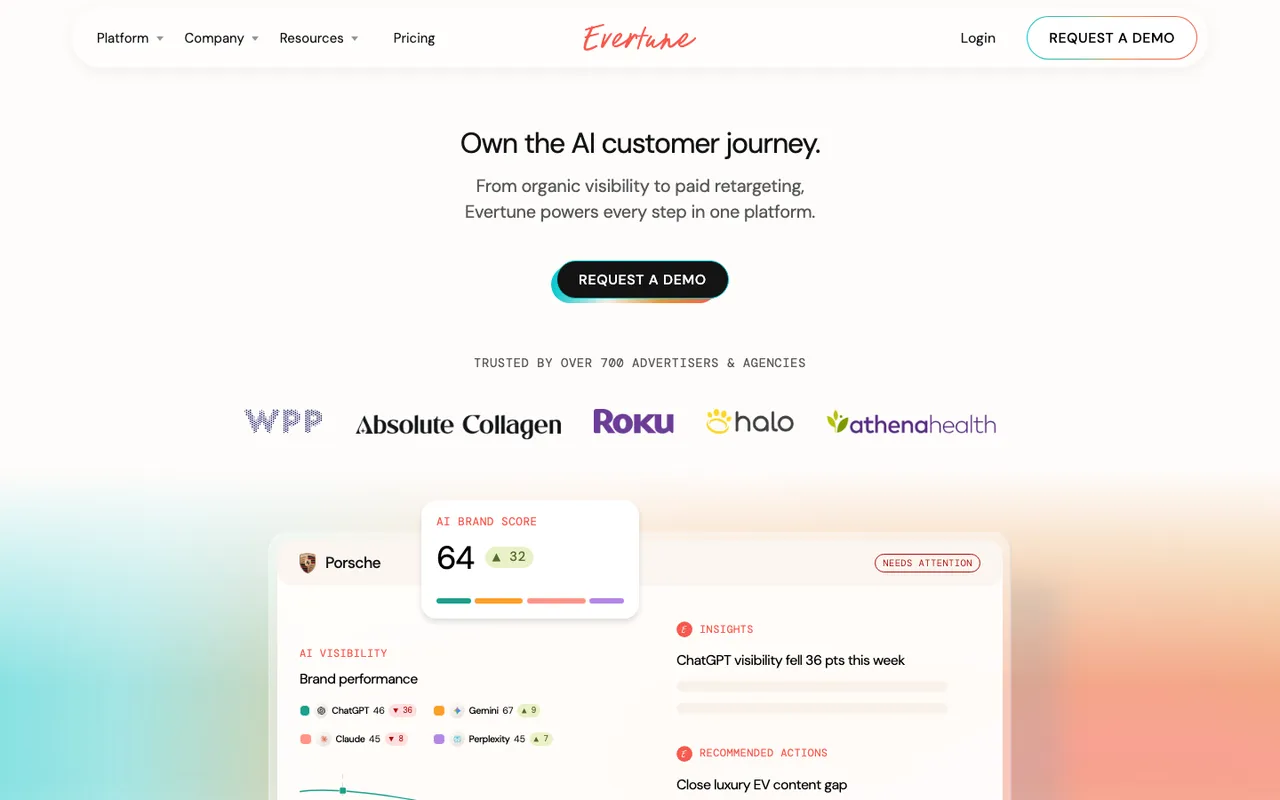 Evertune's homepage, captured November 6, 2026.
Evertune treats AI visibility as market research. It samples each prompt up to 100 times per model across 11 models and ties prompts to EverPanel, a panel of more than 150 million user prompts. Its homepage pitches the journey "from organic visibility to paid retargeting", and its agents include ChatGPT ad campaigns built from visibility data. Prices aren't published. It's a fit for brand and insights teams who need statistically defensible perception numbers, less so for an SEO team that has to fix pages.
Brandlight targets Fortune 500 marketing teams with a multi-brand, multi-region command center, SOC 2 Type II, SSO, and role-based access, plus a service layer of AI strategists. It splits next steps by team (AEO, web, content, e-commerce, PR, paid, social). Prices aren't published, so budget for a sales conversation before you can compare it on cost.
Who should pick which
- A central SEO or GEO team that has to pass security review and prove revenue: Promptwatch. Pilot on Business with the trial, then move to Enterprise for SSO and the success manager.
- A large content team that wants a daily task queue and can budget the custom tier: AthenaHQ Enterprise.
- A Sitecore shop, or a team that wants to change what crawlers read: Scrunch Enterprise.
- A CMO organization buying agents across content, demand, and PR: Profound Enterprise.
- An insights team that needs research-grade brand perception data: Evertune.
- A global consumer brand that wants strategist support built in: Brandlight, compared against Promptwatch on the same prompts.
How to run the comparison yourself
Pick two markets and around 100 prompts that map to revenue. Ask every vendor the same four things in writing: the SSO protocol and the audit log scope, the compliance documents they will share before contract, how usage is counted when you add a market, and how AI-referred traffic is attributed to conversions on your own site. Then check the answers against a real week of data.
For Promptwatch, the quickest way to get those four answers is a call: book a Promptwatch demo and bring your security questionnaire.