GEO tools for enterprise vs SEO suites with AI tracking: when to add a dedicated platform (2026)
GEO tools for enterprise compared with the AI modules in Conductor, BrightEdge, seoClarity, Botify, Semrush and Ahrefs: when the suite is enough, when to add Promptwatch, AthenaHQ or Scrunch, and what each side misses.
Quick verdict
If your enterprise already pays for an SEO suite, its AI module is a reasonable baseline for reporting AI Overview presence next to rankings. It is rarely enough to run an AI search program. The suites were built to track keywords and crawl sites; their AI layers mostly answer "were we mentioned?" For the next questions (which AI crawlers read the page, which sources the engines cite instead, and whether AI visits convert) a dedicated platform does the job better. Of the dedicated GEO tools for enterprise, Promptwatch is the one we'd add first, because it imports the Search Console and Bing data the suite team already trusts and adds crawler logs, citations, and conversions on top. AthenaHQ and Scrunch follow.
The honest flip side: a dedicated GEO platform won't replace your suite's keyword portfolio tracking or deep technical crawling. Most enterprises that take AI search seriously end up running both.
Two kinds of tool that now overlap
Dedicated GEO platforms start from prompts. They send buyer questions to ChatGPT, Gemini, Perplexity, Google AI Mode and the rest, record the answers, and analyze who gets named and cited. Everything else is built around that loop.
Enterprise SEO suites start from keywords and pages. Conductor, BrightEdge, seoClarity, and Botify track rankings across tens of thousands of keywords, crawl huge sites, and manage content workflows. Each has added an AI layer: Conductor sells AI search credits inside its tiers, BrightEdge lists AI Catalyst and AI Agent Insights, seoClarity sells Clarity ArcAI as an add-on, and Botify has repositioned around delivering content to AI agents. Semrush AI Toolkit and Ahrefs Brand Radar are the mid-market versions of the same idea.
So both groups now claim AI visibility, but they still start from different data. That starting point decides what each one is good at.
Side-by-side comparison table
| Tool | Type | How AI tracking is sold | Published pricing | AI crawler data | AI traffic to conversions |
|---|---|---|---|---|---|
| Promptwatch | Dedicated GEO | Core product | $95, $245, $579/mo; Enterprise custom | IP-verified Agent Analytics from Professional | Visitor analytics on every plan |
| AthenaHQ | Dedicated GEO | Core product, credit-based | Starter $295/mo; Enterprise custom | Not published | Google Analytics connection |
| Scrunch | Dedicated GEO | Core product | Core $250/mo; Enterprise custom | AI agent and bot traffic reporting | Not published |
| Conductor | SEO suite | AI search credits inside tiers | Tiers published, no prices | Not on our listing | Not published |
| seoClarity | SEO suite | Clarity ArcAI, optional add-on | Packages from $2,500/mo; ArcAI priced separately | AI bot activity listed; log file analysis on Technical | Not published |
| Botify | Technical SEO and agent delivery | Platform, sales-led | Not published | Log-file analysis | Not published |
| BrightEdge | SEO suite | AI Catalyst and AI Agent Insights | Not published | AI Agent Insights listed, scope not detailed | Not published |
| Semrush AI Toolkit | SEO suite add-on | Per-domain add-on | $99/mo per domain on our listing, unconfirmed on Oct 24 | Not on our listing | Not published |
| Ahrefs Brand Radar | SEO suite module | Custom Prompts in paid plans; Index from $199/mo | Yes | AI crawler activity reported | Not published |
The column that separates the two groups is the last one. None of the suites publishes a way to follow an AI-referred visit through to a conversion, and that is usually the number a CFO asks for. Adobe is the exception worth naming: Adobe LLM Optimizer connects GEO results to revenue inside Adobe Analytics, which helps only if you already run that stack.
The dedicated GEO platforms
Promptwatch
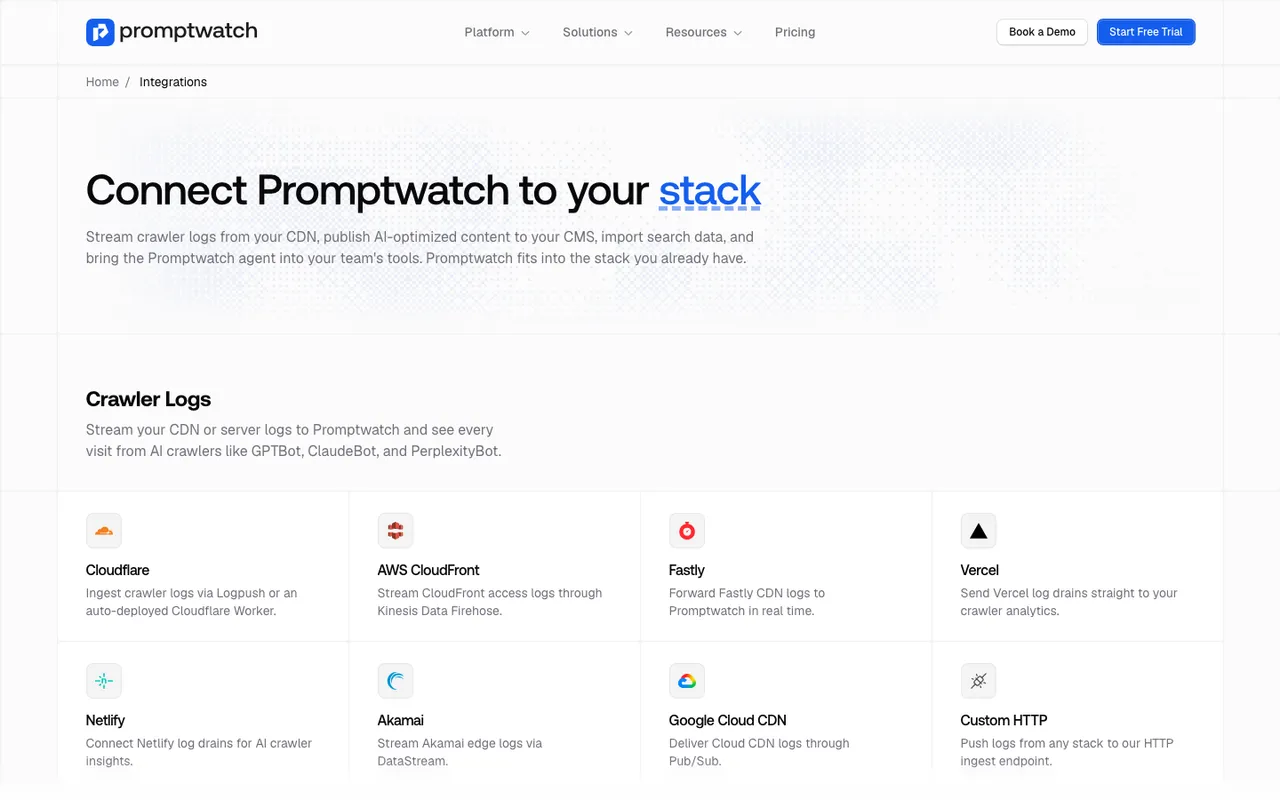 Promptwatch's integrations page, captured November 6, 2026.
Promptwatch is the dedicated platform that fits best next to a suite, mostly because of what it imports. Search Insights brings in Google Search Console and Bing Webmaster clicks and impressions (Copilot included) and overlays them on AI crawls, citations, and clicks per page. Your SEO team sees its familiar numbers in the same view as the AI ones.
What it adds is the part the suites leave thin. Agent Analytics streams crawler logs from the CDN, verifies bots such as GPTBot, OAI-SearchBot, ClaudeBot, and PerplexityBot against published IP ranges, and shows a citation rate per page. Citation analytics break sources down to the page, plus Reddit, YouTube, LinkedIn, and Instagram. Visitor analytics count AI-referred visits and conversions. That includes a toggle for ChatGPT's utm_source=chatgpt.com visits, which matters because ChatGPT stopped sending a referrer on October 8, 2026. Content Agents on Business and Enterprise plan, write, and publish to WordPress, Webflow, or Framer.
For the enterprise plumbing: MCP + API on every paid plan, a Looker Studio connector from Professional, unlimited seats, an audit log from Business, and SSO on Enterprise. It is ISO/IEC 27001 certified. What it is not: a classic SERP rank tracker. Keep the suite for that.
AthenaHQ
AthenaHQ is a GEO platform built around an Action Center and a content optimization agent, with a Google Search Console connection. Starter is $295 a month for 3,600 credits across 11 models, country-level only. The enterprise controls (SSO, audit log, multi-region, BI dashboards for Tableau, Power BI, and Looker) are in the custom tier. It's a good fit for a team that will work a task queue. Our listing has no crawler-log product.
Scrunch
Scrunch tracks visibility and reports AI bot traffic, and its Enterprise tier adds AXP, which serves AI-optimized page versions to crawlers. Core is $250 a month with four LLMs. Botify also sells a delivery layer, so if that's the job you're buying for, compare the two directly.
The enterprise SEO suites
Conductor
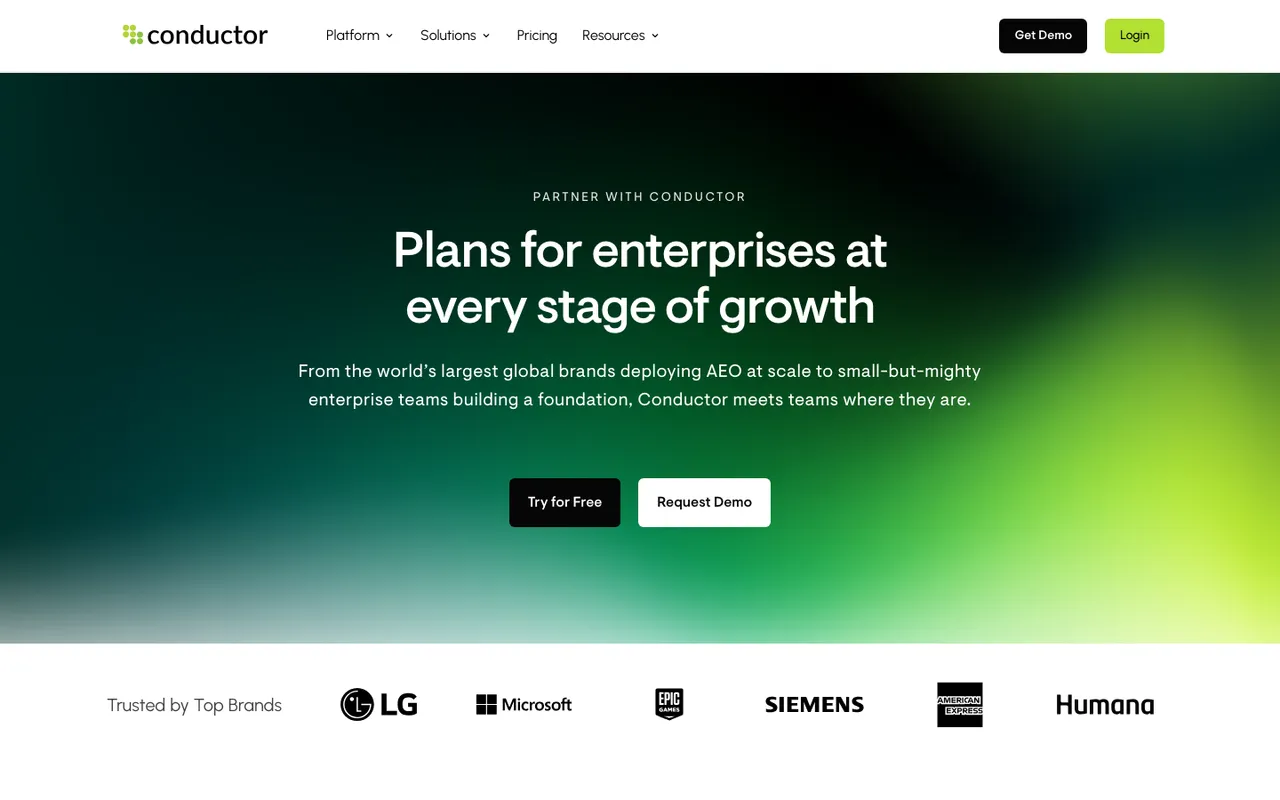 Conductor's pricing page, captured November 6, 2026.
Conductor publishes tiers without prices. Growth lists 5,000 keywords and 2,500 AI search credits a year; Enterprise lists 60,000+ keywords, 75+ competitors, and 2,500+ AI search credits a year. That ratio says something. The AI layer is sized as a supplement to keyword tracking, not as the main event. Conductor's strength is editorial workflow with tasks and approvals. Our catalog entry quotes its own G2 reviewers saying the AI visibility layer "doesn't yet provide the depth of insight we need to act confidently."
seoClarity
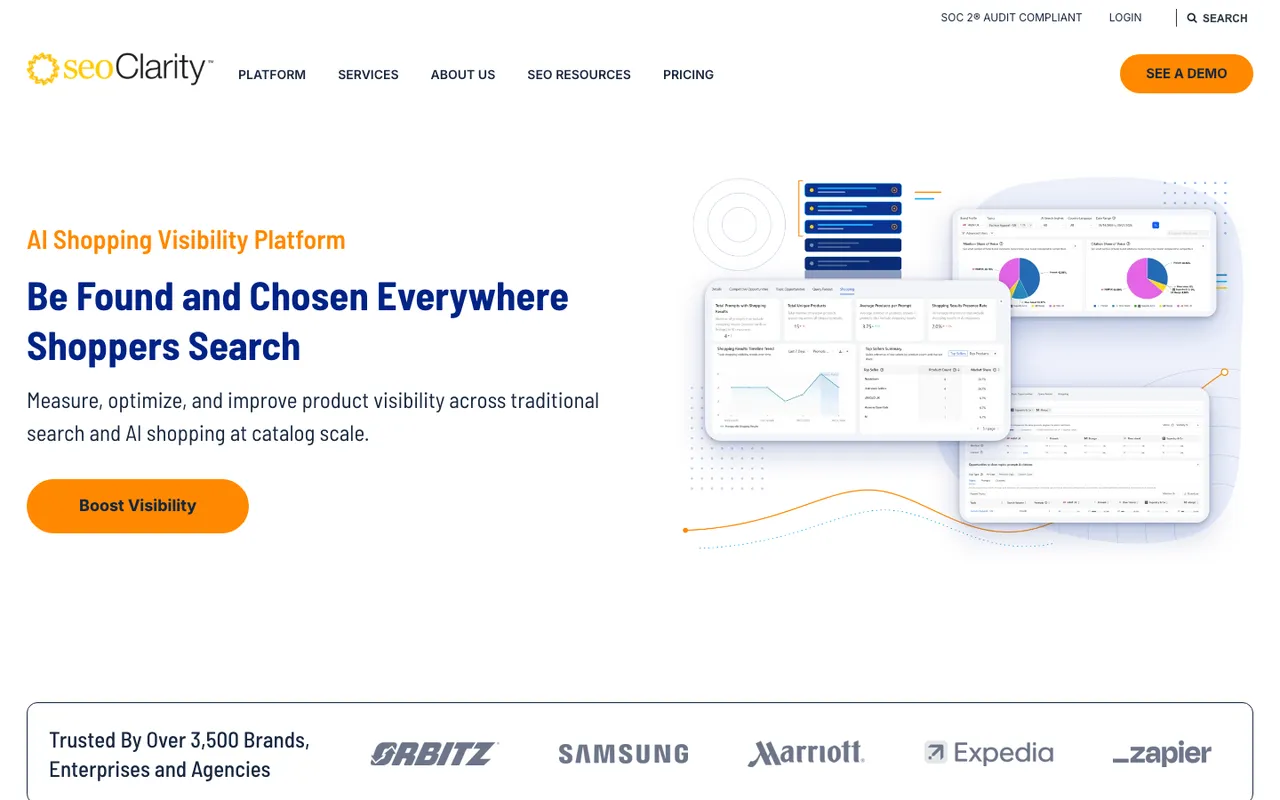 seoClarity's homepage, captured November 6, 2026.
seoClarity has the broadest AI feature list of the suites. Clarity ArcAI covers brand citations and mentions, prompt research, sentiment, AI bot activity, hallucination monitoring, AI shopping capture, and an MCP server and API. The packages publish starting prices (Research & Content from $2,500 a month, Technical from $3,200, Enterprise from $4,500), all priced by domains and keywords, with unlimited users. ArcAI is an optional add-on on top. For a retailer already on seoClarity, ArcAI deserves a trial before you add another vendor.
Botify
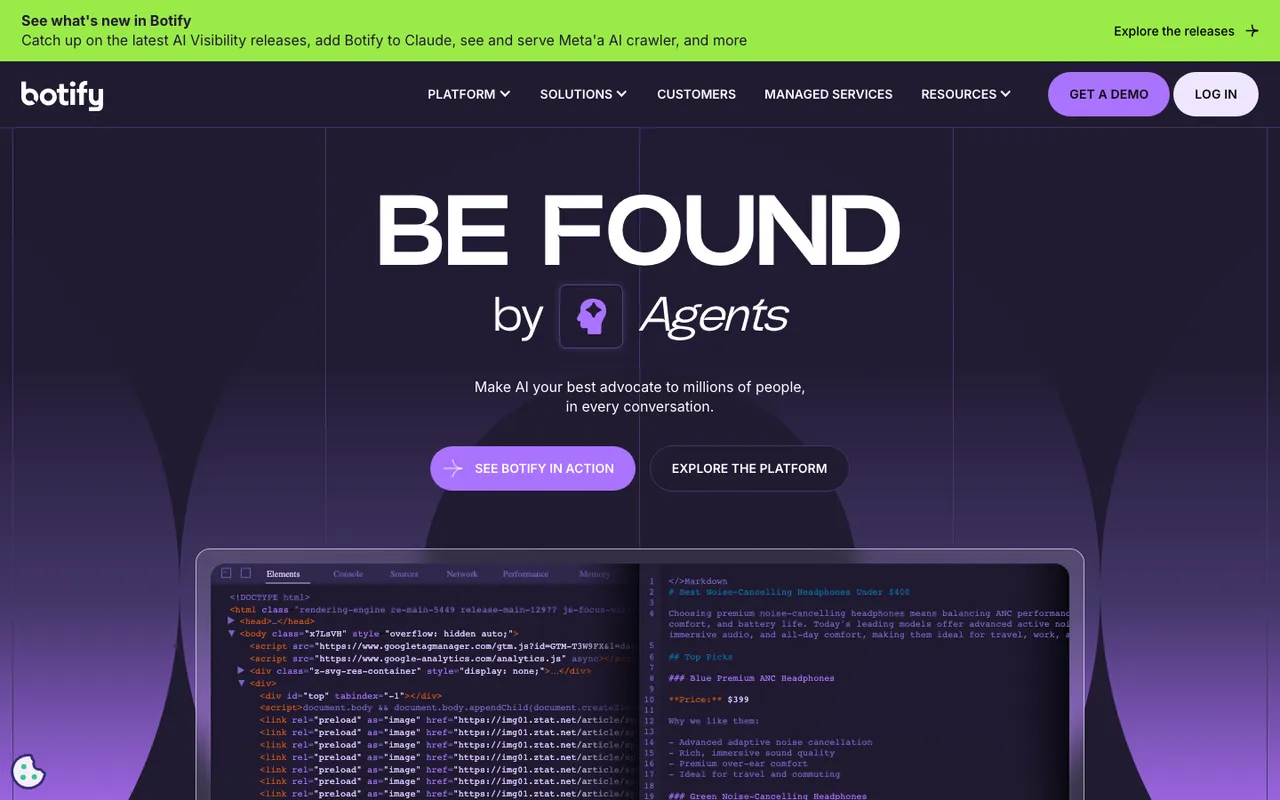 Botify's homepage, captured November 6, 2026.
Botify is infrastructure. It serves content to agents in under 300ms, rebuilds product feeds for Google and OpenAI, delivers Markdown to agents, and analyzes log files. That's a real GEO job. It isn't prompt tracking, and our listing says plainly that Botify doesn't replace a multi-engine prompt tracker. If rendering and feed delivery are your bottleneck, Botify fits. If the question is "did ChatGPT name us and send a visit", it doesn't answer that.
BrightEdge, Semrush, and Ahrefs
BrightEdge lists AI Catalyst, AI Agent Insights, an MCP connector, and Autopilot, and doesn't publish prices. Treat third-party contract estimates as estimates.
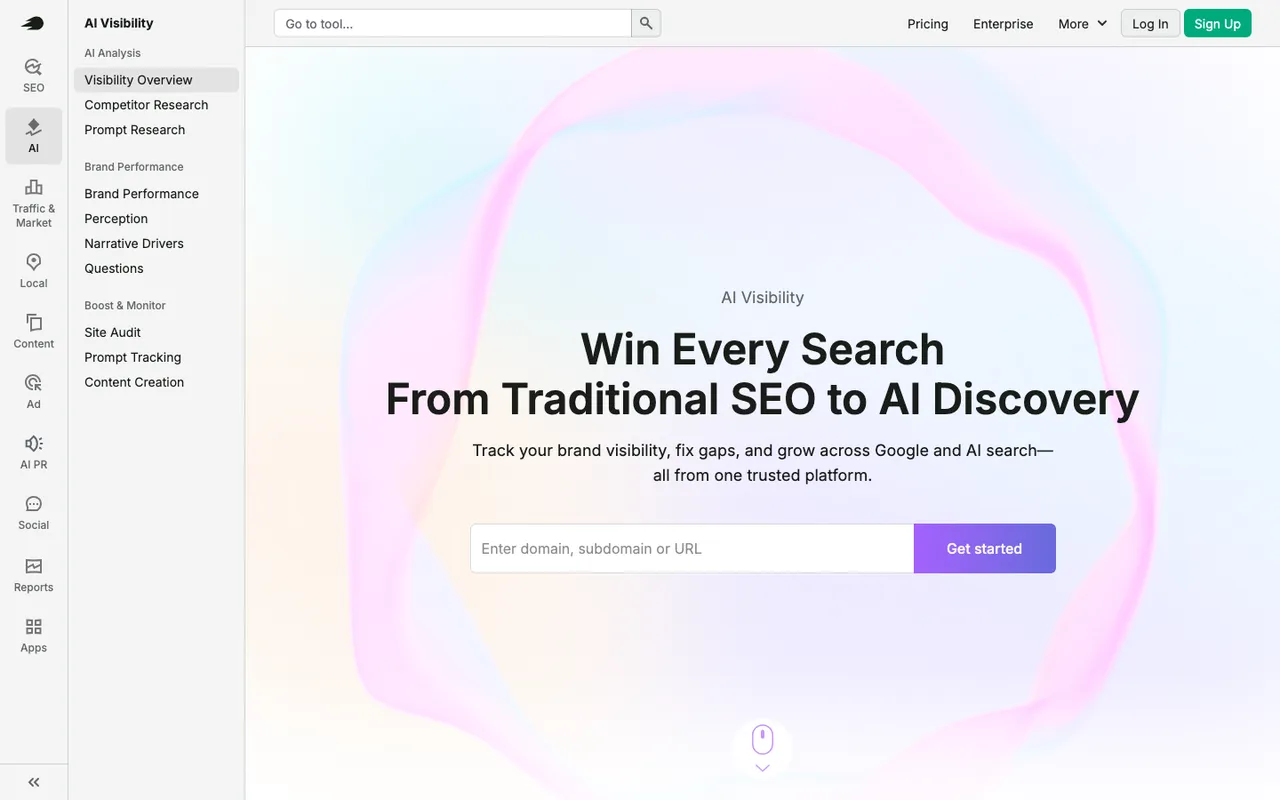 Semrush's AI Visibility page, captured November 6, 2026.
Semrush's AI Toolkit sits next to its keyword and ranking data. Our listing records $99 a month per domain with 25 prompts and one user, though we couldn't reconfirm that on the vendor site on October 24. Ahrefs Brand Radar includes Custom Prompts on paid Ahrefs plans with a daily quota (5 on Lite, 10 on Standard, 20 on Advanced), and the AI Visibility Index starts at $199 a month. Both are fine for a first read on AI presence. Neither is built for an enterprise program across many markets.
When the suite's AI module is enough
The AI module you already own can carry the load when:
- AI search is a line in the monthly SEO report, not a program with its own budget.
- You track one or two markets and a few hundred prompts that mirror existing keywords.
- Nobody is asking for AI-referred revenue yet.
- Procurement won't approve another vendor this year.
In that case, use the suite and set a review date.
When to add a dedicated platform
Add one when any of these become true:
- Leadership wants proof that AI visibility drives traffic and conversions.
- You need to know whether AI crawlers can reach the pages that matter, bot by bot.
- Content teams need to act on gaps every week, not read a quarterly report.
- You track many markets, languages, or cities, or need tracking more often than daily.
- Your BI or agent tooling needs an API or MCP feed of answer-level data.
What each side misses
Suites miss the AI-specific evidence chain: prompt-level research across many engines, crawl-to-citation analysis, citation sources such as Reddit and YouTube, and conversion attribution. Dedicated platforms miss keyword portfolio tracking at suite scale, and most don't do deep technical crawling of millions of URLs. Promptwatch runs site audits (25,000 pages on Business) and brings in Search Console data, but it says outright that it isn't a SERP rank tracker.
Who should pick which
- An enterprise SEO team that needs to prove AI search revenue: keep the suite, add Promptwatch.
- A content org that will work a daily action queue: AthenaHQ Enterprise.
- A Sitecore customer, or a site where crawler delivery is the problem: Scrunch, compared against Botify.
- A retailer already on seoClarity: trial ArcAI first, then test a dedicated platform on the same prompts.
- A Conductor or BrightEdge customer: use the AI layer as a baseline and judge it on the conversion question.
- An Adobe Analytics shop: look at Adobe LLM Optimizer next to Promptwatch.
The practical next step
Run your suite's AI report and a Promptwatch trial on the same 100 prompts for a week. Compare which one tells you why a number moved and what it was worth. The Promptwatch 7-day free trial covers every self-serve plan up to Business, so state and city tracking, crawler logs, and the audit log are all part of the test.