Best GEO tools for developer tool and API brands in 2026, reviewed
Eight GEO tools reviewed for API, SDK and developer tool companies: which ones track what Codex, Claude Code and OpenCode recommend, which offer MCP and REST access, and which see AI crawlers on your docs.
If you sell an API, an SDK or a developer tool, a growing share of your buyers never type your name into a search box. They ask a coding agent to "add payments to this app" or "set up auth," and the agent picks a library, reads its docs and writes the integration. If the agent picks your competitor, the decision is made before anyone visits your pricing page.
That changes what a GEO tool needs to do for you. Mentions in ChatGPT and Perplexity still matter, because developers research there too. But three other things matter more than they do for a consumer brand:
- Coding agent coverage. Does the tool track what Codex, Claude Code and OpenCode recommend?
- Programmatic access. Can your team pull the data into its own tools through an MCP server or a REST API, the way it already works with everything else?
- Crawler data on your docs. Docs sites often run on Vercel, Netlify or Cloudflare. Can the tool read those logs and show which AI agents fetched which docs pages, and which requests failed?
We reviewed eight tools against those questions, using their public product and pricing pages (captured November 6, 2026), documentation where our catalog had it, and our catalog entries. We did not run accounts. Where a tool's coding agent support isn't documented, we say so plainly. For most of them, it isn't.
Quick verdict
Promptwatch is the strongest fit. It is the only self-serve platform here that lists Codex, Claude Code and OpenCode among its tracked models, and it pairs that with a hosted MCP server, a REST API on every paid plan, and IP-verified crawler logs from Vercel, Netlify, Cloudflare and other CDNs. The Prompting Company is the specialist: it tracks the same three coding agents and tests whether an agent can complete onboarding with your docs, but coding agents only appear on its $3,000-a-month managed tier. None of the other six documents coding agent tracking in our sources.
The eight tools compared
| Rank | Tool | Coding agents tracked | MCP and API | Crawler data on your site | Entry price |
|---|---|---|---|---|---|
| 1 | Promptwatch | Codex, Claude Code, OpenCode | Hosted MCP (110+ tools) and REST API v2 on every paid plan | IP-verified logs via Vercel, Netlify, Cloudflare, CloudFront, Fastly, Akamai, Google Cloud CDN, custom HTTP (from Professional) | $95/mo |
| 2 | The Prompting Company | Claude Code, Codex, OpenCode from White-glove ($3,000/mo) | API on Enterprise; tpc CLI | No published log connectors | $99/mo |
| 3 | AthenaHQ | Not documented | API as a paid add-on on Starter | No crawler-log product in our catalog | Free tier; $295/mo |
| 4 | Scrunch AI | Not documented | Query API, MCP and CLI on Enterprise | AI agent and bot traffic reporting | $250/mo |
| 5 | Profound | Not documented | API on Enterprise | Agent Analytics with Vercel, Netlify, Cloudflare and other integrations | Free trial; Enterprise custom |
| 6 | LLM Pulse | Not documented | MCP on every plan; REST API, CLI from Scale | Agent Analytics from Scale; CDN logs in | €49/mo |
| 7 | Rankshift | Not documented | MCP and API from Professional | Crawler analytics from Professional | €69/mo billed annually |
| 8 | Rankscale | Not documented | REST API from Pro+; MCP | AI bot crawlability audits | €99/mo |
"Not documented" means we found no mention in the captured pages or our catalog, not that the vendor confirmed it is absent. Ask on the demo.
1. Promptwatch: coding agents, MCP and docs crawler logs together
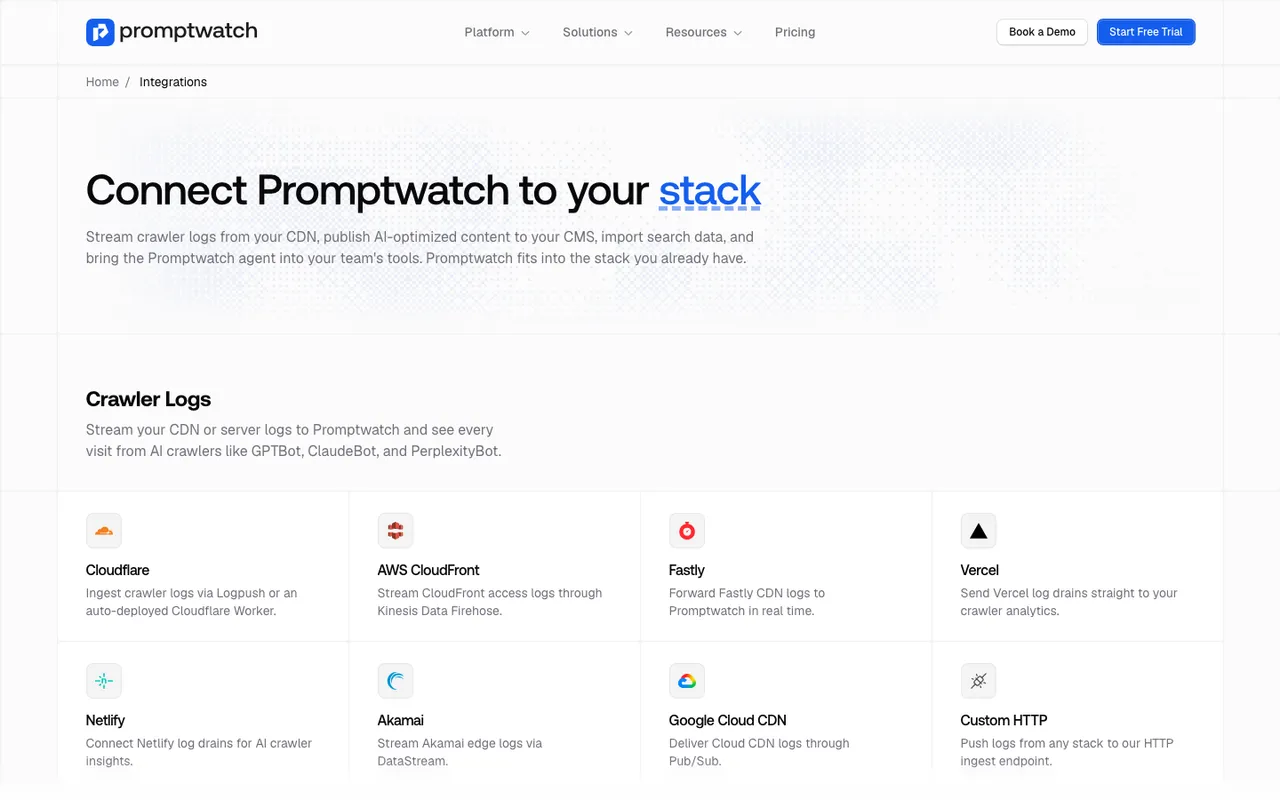 Promptwatch's integrations page, captured November 6, 2026.
Promptwatch tracks what Codex, Claude Code and OpenCode recommend: tools, libraries and docs. Its pricing page lists all three among the supported models, and every paid plan can track any of the supported engines. That sits next to real-interface tracking of ChatGPT, Google AI Overviews, Google AI Mode, Gemini, Perplexity, Copilot, Amazon Alexa and Meta AI. A separate set of API-tracked models (Claude, DeepSeek, Mistral, Grok and others) shows what models answer from training data. For a developer brand, that split is useful. An agent that searches the web and a model answering from memory can recommend different libraries, and you want to see both. Our explainer on API-tracked versus real-UI tracking covers why the two differ.
The developer access is the deepest on this list. A hosted MCP server at https://server.promptwatch.com/mcp exposes 110+ read and write tools, authenticates with OAuth or an API key, and works with Claude, Claude Code, ChatGPT, Cursor (one-click install), Lovable and Codex. The REST API v2 lives at https://server.promptwatch.com/api/v2, takes an X-API-Key header and accepts date ranges up to 92 days. API keys can be scoped to a project, an organization or read-only. Rate limits scale by plan: 500 requests an hour on Essential, 2,000 on Professional, 10,000 on Business and 50,000 on Enterprise. In practice your team can ask Claude Code which prompts you lost this week without opening a dashboard.
Then there is the docs site. From Professional ($245 a month), Agent Analytics ingests logs from Vercel and Netlify log drains, Cloudflare, AWS CloudFront, Fastly, Akamai, Google Cloud CDN or a custom HTTP endpoint. Every hit is checked against each operator's published IP ranges, so spoofed user agents are filtered out. You see which pages ChatGPT-User, Claude-User, PerplexityBot and the other agents fetched, a citation rate per page, and error tracking with failure explanations. For an API company, a quickstart that returns errors to ClaudeBot is a sales problem, and this is where it shows up.
Before you buy anything, Promptwatch's free Agentic Readiness Check tests robots.txt against nine AI crawlers and looks for llms.txt, MCP server cards, A2A agent cards, OAuth discovery and Content Signals. It is a quick check on whether agents can find and use your product at all.
Limits: crawler logs need Professional, and Essential's 500 requests an hour won't suit heavy automation. The coding agent view shows what the agents recommend. It doesn't run a sandboxed onboarding test the way The Prompting Company's Enterprise audit does.
2. The Prompting Company: agent onboarding tests, at a managed price
The Prompting Company is the one other tool in our catalog built around coding agents. Its upper tiers track Claude Code, Codex and OpenCode. The distinctive feature is the Agent Experience Benchmark, in which a coding agent reads a product's docs and runs a real onboarding task in a fresh sandbox, scored by an independent judge. On Enterprise, an Agent Experience audit maps the tasks agents run for users and surfaces friction such as a misconfigured API setup, missing docs or unclear errors. It also offers Google Analytics and PostHog integrations and a tpc CLI.
The pricing is where it gets hard. Per our catalog, Basic is $99 a month for 25 prompts on ChatGPT, Perplexity and Gemini with one seat. Pro is $299 for 100 prompts and 8 articles. Coding agents, Claude and DeepSeek only appear on White-glove at $3,000 a month, a managed service. The Agent Experience audit is Enterprise. Our catalog lists no published crawler-log connectors or conversion tracking.
It suits developer tool companies with the budget for a managed program whose main question is "can an agent actually onboard with us?" For measuring and reporting, it is thinner than Promptwatch.
3. AthenaHQ: broad models, no coding agents in our sources
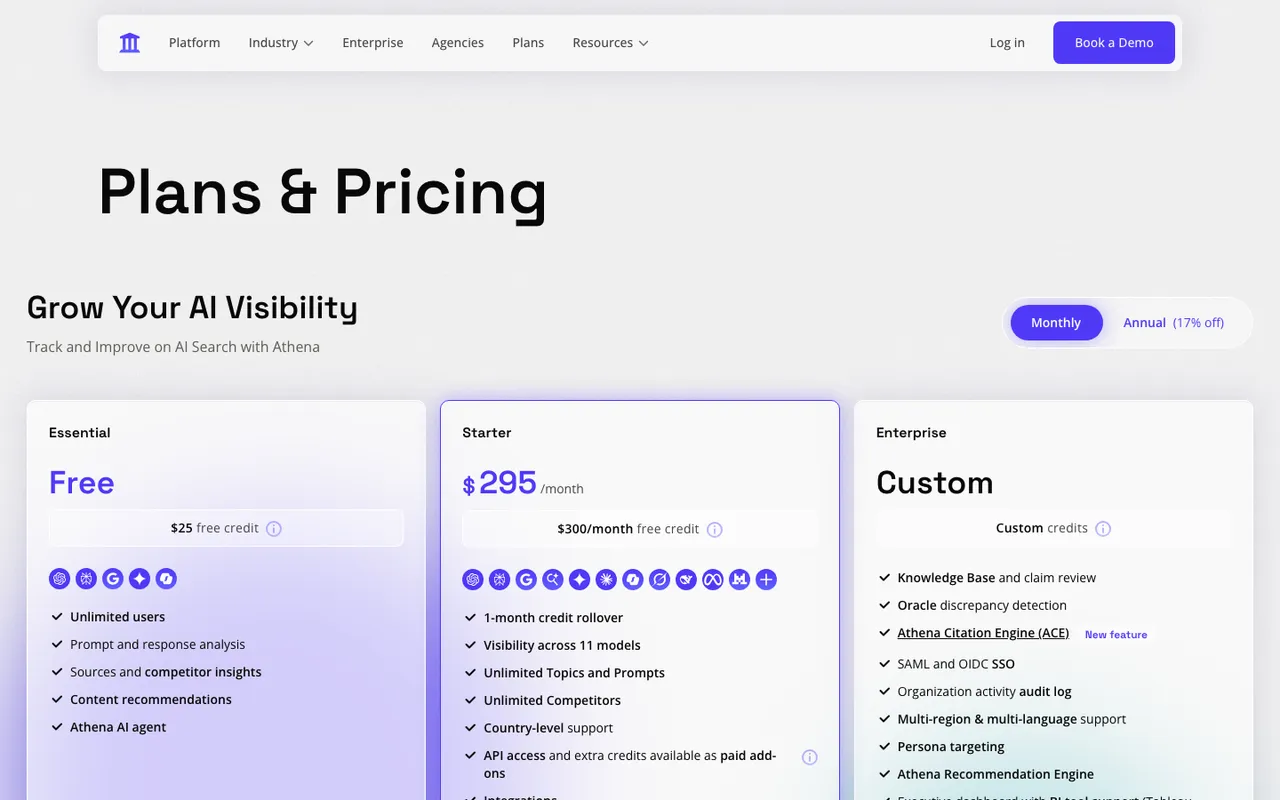 AthenaHQ's pricing page, captured November 6, 2026.
AthenaHQ Starter ($295 a month) covers 11 models: ChatGPT, Perplexity, AI Overviews, AI Mode, Gemini, Claude, Copilot, Grok, DeepSeek, Meta AI and Mistral, with more "available upon request." That is good breadth for the research side of a developer's journey. We found no coding agents in the sources we read. API access is a paid add-on on Starter, priced on request, and our catalog lists no crawler-log product, although the pricing table includes a smart robots.txt and llms.txt manager for crawler access.
It suits a dev tool marketing team that wants an action queue across the chat engines and doesn't need agent or log data yet.
4. Scrunch AI: agent-facing pages, developer access on Enterprise
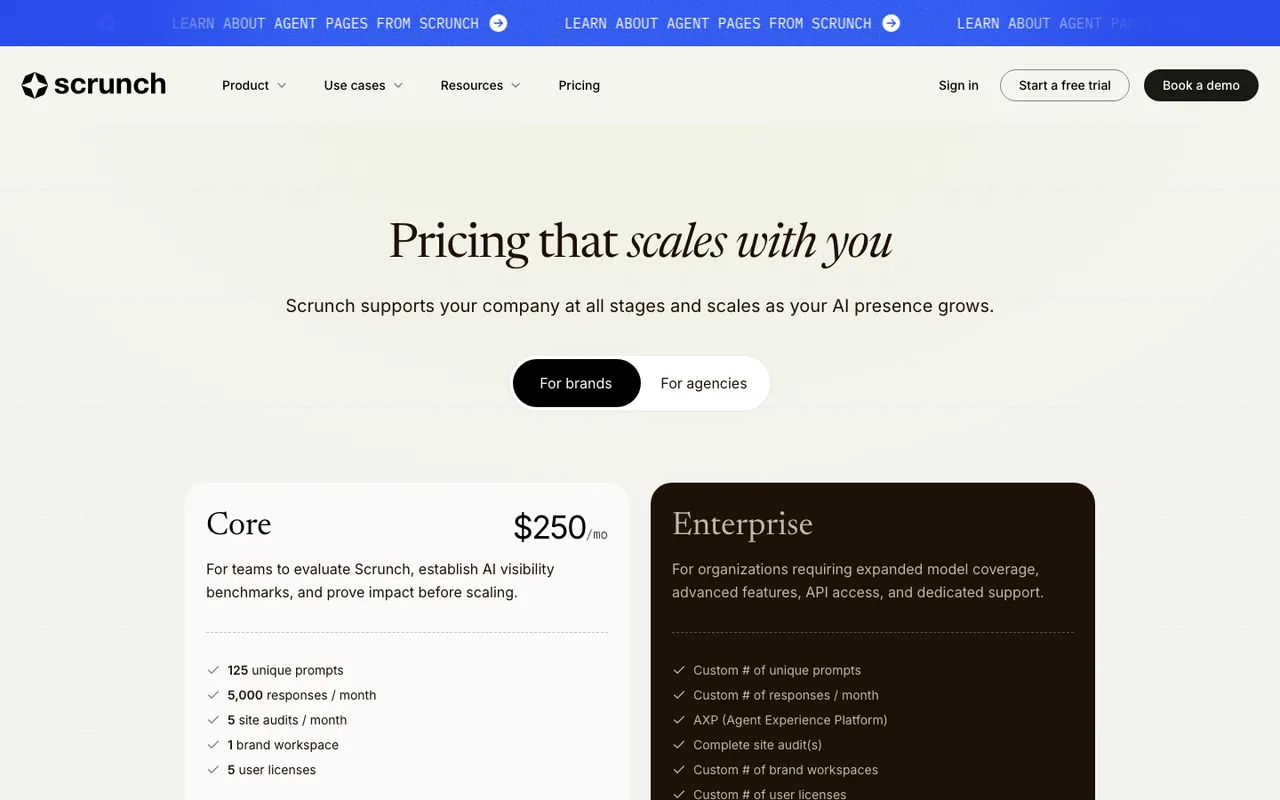 Scrunch AI's pricing page, captured November 6, 2026.
Scrunch AI is interesting for docs-heavy companies because of AXP, which serves AI-optimized versions of pages to agents without changing what humans see. That, Query API access, advanced API access, MCP and CLI access are all Enterprise. Core ($250 a month) tracks four LLMs and includes AI agent and bot traffic reporting, site audits and a 7-day free trial. No coding agents are documented.
5. Profound: CDN integrations and an Exa signal
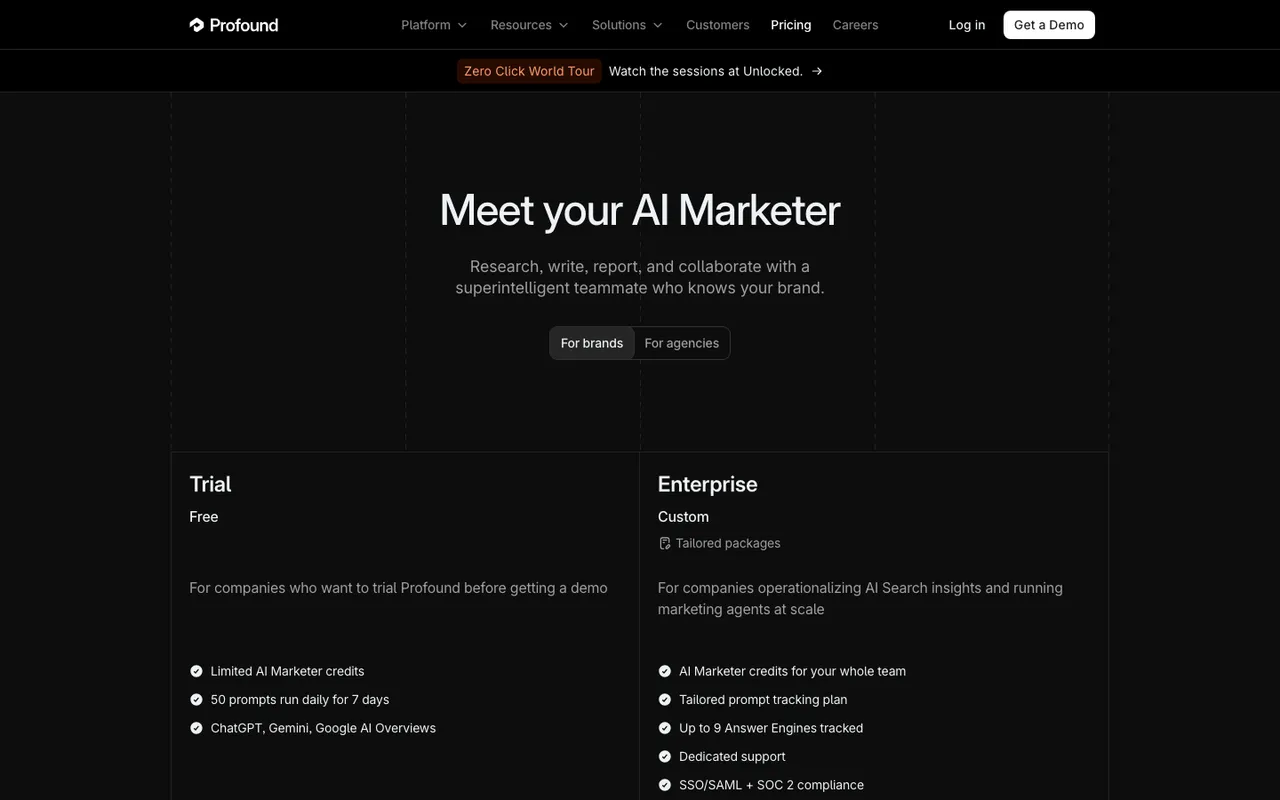 Profound's pricing page, captured November 6, 2026.
Profound lists Agent Analytics with integrations for Vercel, Netlify, Cloudflare, Fastly, Akamai, AWS and Google Cloud, which fits the hosting setups most docs sites use. Its Enterprise engine list includes Exa Search next to ChatGPT, Perplexity, Gemini, Claude and others. Exa is the web search OpenCode uses, according to Promptwatch's documentation, so it is the closest thing to a developer-agent signal on the page. No coding agents are named, though. API access is Enterprise only, and no prices are published. Our catalog places Profound below the dedicated AI search platforms because it sells a broad marketing-agent program more than an AI search tracker.
6. LLM Pulse: a developer-friendly surface, no coding agents listed
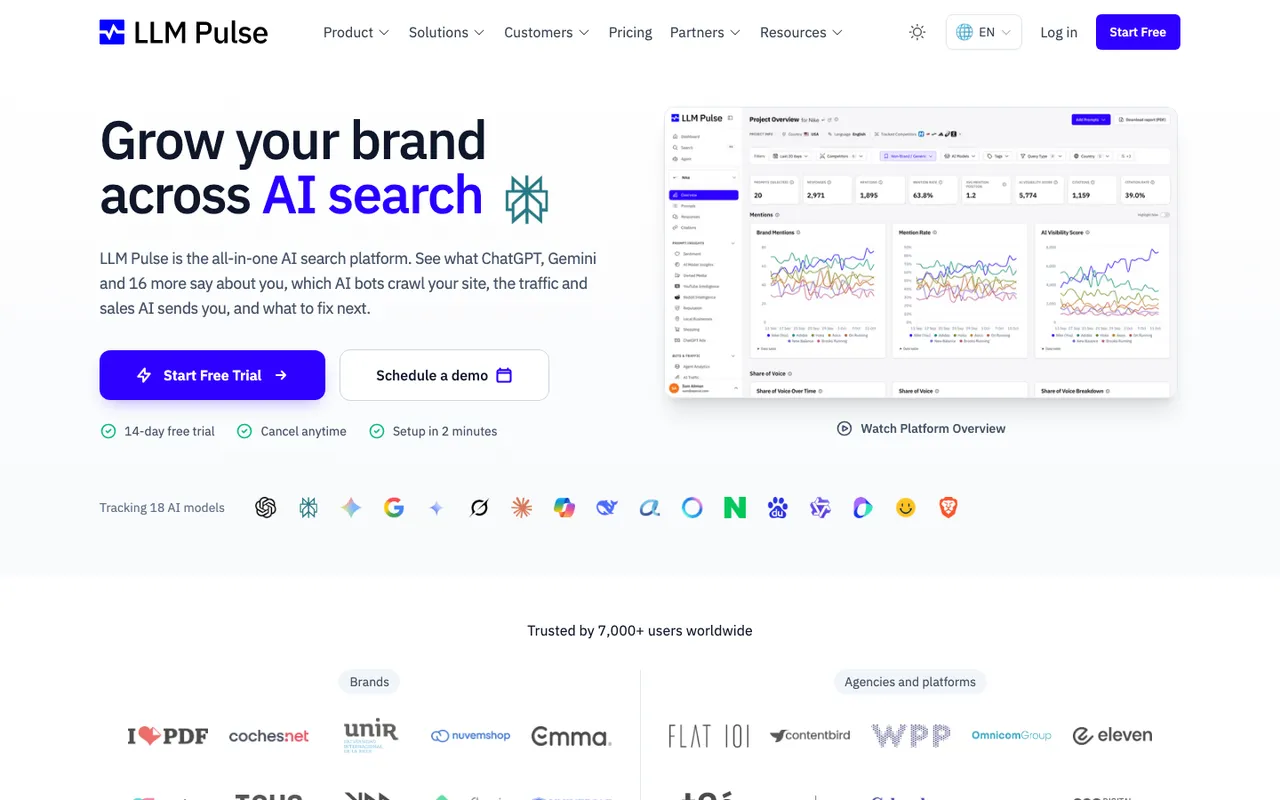 LLM Pulse's homepage, captured November 6, 2026.
LLM Pulse has one of the better developer surfaces for its price. The homepage describes an MCP server with about 140 tools and OAuth sign-in, a REST API with JSON, CSV and webhooks, a CLI, and SDKs in 12 languages. It can take CDN logs in. The pricing page puts the MCP server on every plan, while the API, CLI and Agent Analytics start on Scale (€299 a month). Starter is €49 a month with weekly tracking, and there is a 14-day free trial. The homepage says it tracks 18 AI models, with five core models on every plan and others as paid add-ons. We found no coding agents among them.
7. Rankshift: crawler analytics and MCP from Professional
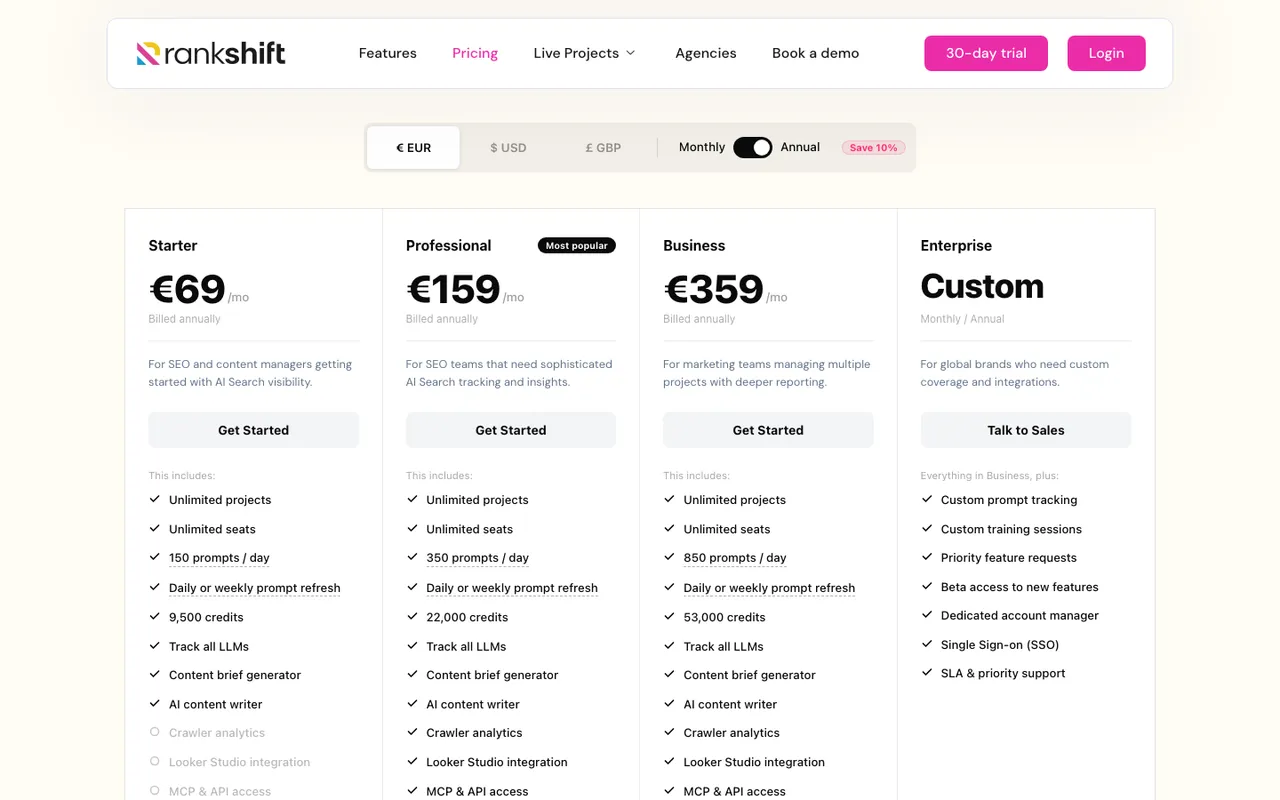 Rankshift's pricing page, captured November 6, 2026. Prices shown in euros for a visitor in the Netherlands.
Rankshift tracks a long list of LLMs, including ChatGPT, AI Mode, Gemini, Claude, Copilot, Perplexity, Mistral, Meta AI, Grok and DeepSeek, with unlimited projects and seats. Its homepage shows Agent Analytics reporting GPTBot, ClaudeBot, PerplexityBot, Googlebot, Bingbot and Applebot visits. In the pricing screenshot, crawler analytics and MCP and API access start on Professional (€159 a month billed annually) and are greyed out on Starter. No coding agents are listed.
8. Rankscale: page audits and a REST API
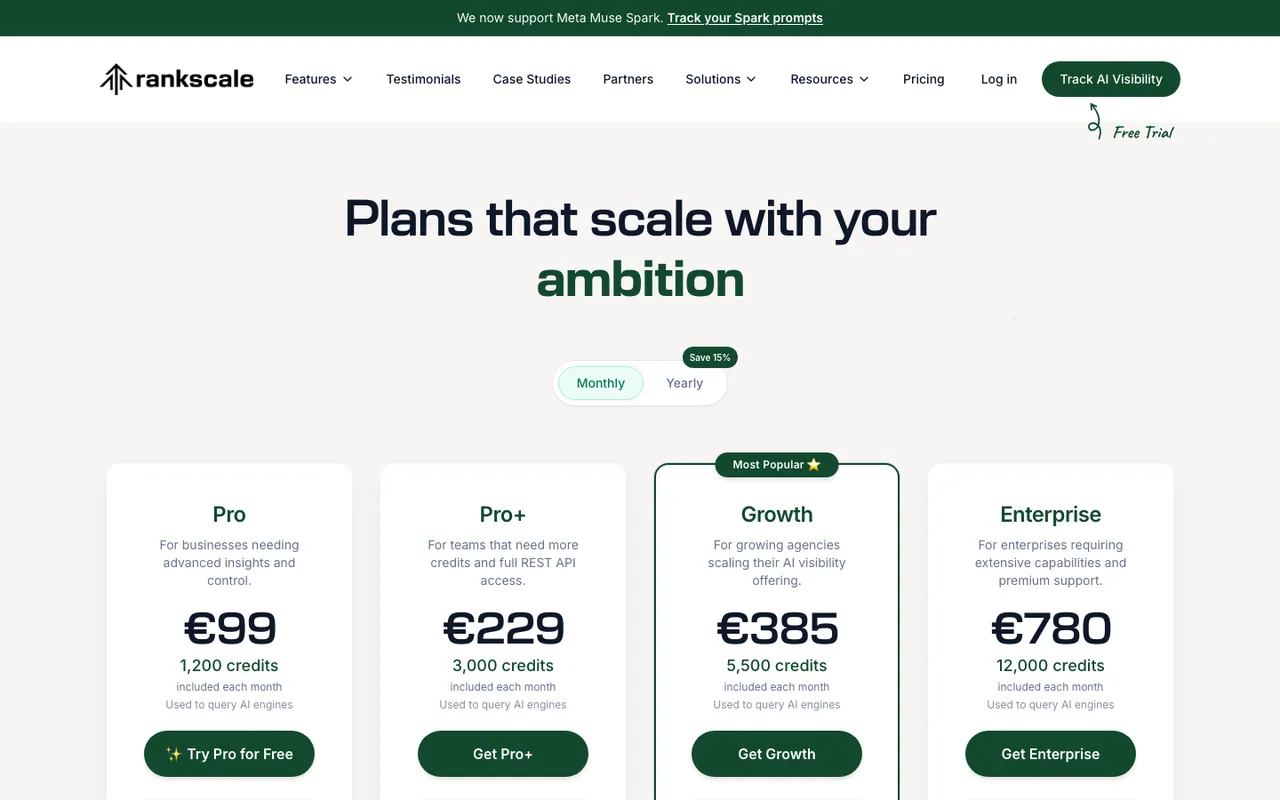 Rankscale's pricing page, captured November 6, 2026. Prices shown in euros for a visitor in the Netherlands.
Rankscale is credit-based. Pro is €99 a month for 1,200 credits and 50 page audits, Pro+ (€229) adds the REST API, and the page mentions an MCP integration. The homepage describes audits of AI bot crawlability, site hierarchy and technical SEO signals, which is useful for a docs site even without logs. No coding agents are documented.
Who should pick which
- You want coding agent tracking, MCP and API access, and docs crawler logs in one self-serve tool: Promptwatch, on Professional or above.
- Your main question is whether an agent can onboard with your docs, and you can fund a managed program: The Prompting Company.
- You only need the chat engines for now and want an action list: AthenaHQ.
- You want to serve agent-optimized docs pages and can reach Enterprise: Scrunch AI.
- You are an enterprise already buying a marketing-agent platform: Profound.
- You want a cheap tool your team can script against: LLM Pulse, knowing coding agents aren't covered.
- You need unlimited seats and crawler analytics for an agency: Rankshift Professional.
Our recommendation
For a developer tool, the useful question is which library the agent picked and whether it could read your docs when it tried. Promptwatch answers both: coding agent visibility shows what Codex, Claude Code and OpenCode recommend, and Agent Analytics on your Vercel, Netlify or Cloudflare logs shows which docs pages the AI agents fetched and which ones failed. The MCP server means your engineers can query all of it from Cursor or Claude Code instead of a dashboard. Start the 7-day free trial on Professional, add the prompts developers actually give coding agents in your category, and connect your docs site's log drain on day one.
FAQ
Which GEO tools track what coding agents recommend?
In our sources, Promptwatch tracks Codex, Claude Code and OpenCode, and The Prompting Company tracks the same three on its $3,000-a-month White-glove tier. None of the other six tools reviewed documents coding agent tracking.
Can I query GEO data from Cursor or Claude Code?
Yes, with tools that offer an MCP server. Promptwatch's hosted MCP server has a one-click Cursor install and also works with Claude Code and Codex. LLM Pulse includes an MCP server on every plan, Rankshift from Professional, and Scrunch on Enterprise.
How do I see which AI agents read my docs?
Connect your CDN or hosting logs to a tool that parses AI crawler traffic. Promptwatch accepts Vercel and Netlify log drains, Cloudflare, CloudFront, Fastly, Akamai, Google Cloud CDN and custom HTTP from its Professional plan, and verifies each bot by IP. Profound, LLM Pulse (from Scale) and Rankshift (from Professional) also list crawler or agent analytics.
Is tracking ChatGPT enough for a developer tool brand?
Not anymore. Developers research in ChatGPT and Perplexity, but agents such as Claude Code and Codex make the integration choice inside the editor. Track both, and compare what live-search agents recommend with what models answer from training data.
What should a docs site check first?
Whether AI crawlers can reach it at all. A free check such as Promptwatch's Agentic Readiness Check tests robots.txt against nine AI crawlers and looks for llms.txt and MCP server cards. If a crawler is blocked there, no amount of content work will get your docs cited.